Prunes

Prunes: Seasonality, Harvest Windows and Crop Planning

A practical trade guide for buyers who need prune programs structured around harvest timing, drying season, stock availability, pack planning and shipment continuity rather than spot pricing alone.

Crop TimingHarvest-linked supply
PlanningProgram visibility
ContinuityShipment discipline
Prunes seasonality harvest windows and crop planning guide

Why this topic matters

Prune trade is not only about grade and price. It is heavily shaped by crop timing, drying yields, available stock, pack conversion capacity and the buyer’s own sales calendar.

Prunes move through several commercial channels at the same time, including bulk industrial use, bakery and cereal manufacturing, foodservice repacking, retail branded packs and private label launches. That means supply planning cannot be handled as a generic commodity exercise. Industrial users may focus on consistent moisture, workable texture, pitting performance and lot continuity, while retail buyers may prioritize pack presentation, size consistency, shelf-life planning and reliable monthly replenishment. The right commercial offer therefore depends on crop timing and stock strategy as much as on the product itself.

Seasonality matters because prune supply begins with fresh fruit harvest, then moves through drying, conditioning, grading, pitting where applicable, packing and export release. Each stage has a commercial consequence. Early-season inquiries may require realistic discussion about fresh-crop timing and initial pack availability. Mid-season programs may have the best range of sizing and pack options. Late-season business often depends on remaining inventories, carryover strategy and whether the buyer can accept alternative sizes, private label lead times or partial shipment scheduling.

For buyers, crop planning is especially important when prunes are part of a stable product line rather than a one-off purchase. Breakfast, bakery, snack and wellness categories usually need continuity across the year. That continuity depends on matching purchase timing to harvest rhythm, reserving suitable grades early enough, aligning packaging procurement and deciding whether the supply model will rely on spot buying, quarterly call-offs or an annual program. A supplier conversation becomes more efficient when demand forecasts, pack formats and expected shipping windows are shared at the beginning.

That is why Atlas treats seasonality, harvest windows and crop planning as a separate article topic. Buyers who understand the crop calendar usually make better purchasing decisions, experience fewer surprises on size availability and manage landed cost more effectively through better scheduling.
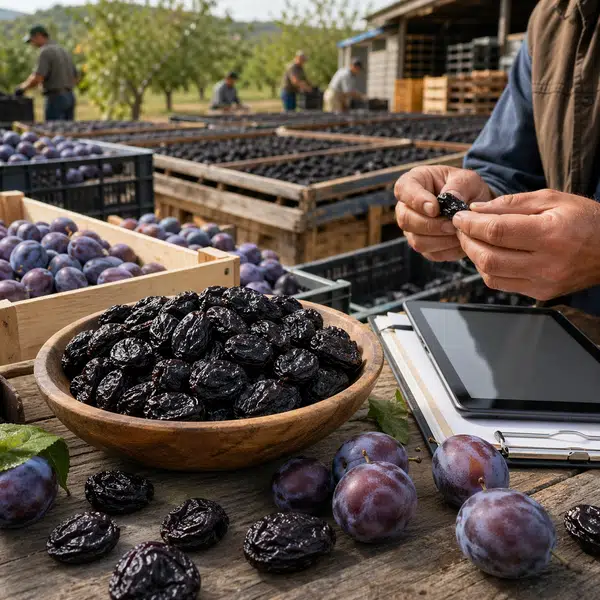
How prune seasonality affects supply programs

Fresh harvest timing is only the starting point. The commercial supply window depends on what happens immediately after harvest and how inventories are managed afterward.

Harvest period

Prune supply begins with the fresh plum harvest and the volume, maturity and fruit condition achieved in that period. Weather, fruit sizing, orchard productivity and drying suitability all influence the commercial quality potential of the season.

Drying and conditioning stage

Fresh fruit must move through drying and stabilization before it becomes a market-ready prune program. This stage affects moisture balance, texture, sweetness concentration, shelf stability and the timing of the first substantial shipment opportunities.

Sorting, grading and pitting

Once the crop is processed, the available range becomes clearer by size, count, visual profile and whether the product will be sold pitted or unpitted. This is often the point where buyers can make more precise program decisions.

Pack conversion and shipment readiness

Retail and private label programs depend not only on fruit availability but also on packaging materials, label approvals, carton planning and export slot scheduling. This means physical stock may exist before every format is shipment-ready.

In practical trade terms, buyers should think of prune seasonality in three layers: the crop window, the processing window and the commercial shipment window. These layers do not always align perfectly. A buyer who understands this can ask better questions about when a fresh crop is expected to become available in the exact format they need.

What buyers should define before asking for a crop-based quotation

A well-structured inquiry helps suppliers distinguish between immediate stock availability, new-crop planning and longer-term program allocation.

End use

Clarify whether the prunes are for direct consumption, bakery, cereal, sauce, filling, confectionery, repacking or wellness-focused retail. End use affects acceptable size, texture and whether pitted format is necessary.

Format

Specify pitted or unpitted, bulk or retail, loose-packed or portion-packed, and whether further cutting, paste preparation or ingredient processing will occur after import.

Grade and size direction

State if the program requires a premium larger fruit profile, a standard commercial grade or a more industrially functional specification. Size distribution and count preference directly affect crop allocation.

Required shipping window

Indicate whether supply is needed immediately, around fresh-crop transition, on monthly release or under a longer call-off structure. Timing is often as important as price.

Program volume

Annual demand estimates, even if approximate, help determine whether the inquiry should be handled as spot stock, reserved production or a structured forward program.

Pack and label structure

Private label and branded retail projects require earlier planning because packaging materials, artwork approval and carton build specifications can influence the first shipment date.

Harvest windows and commercial implications

Different moments in the season create different opportunities and risks for importers, distributors and manufacturers.

Pre-harvest planning phase

Before the crop is fully processed, serious buyers may already begin planning with target sizes, estimated annual needs, certification profile and pack intentions. This is often the right time to discuss reservation logic, especially for more demanding formats or higher-volume programs.

Fresh-crop opening phase

At the beginning of the commercial season, interest tends to focus on new-crop timing, first available lots and expected quality direction. Buyers should remain practical at this stage because exact sizing and pack conversion capacity may still be developing.

Main availability phase

This is typically the most stable period for program building because stock visibility is clearer, grading results are more established and suppliers can offer more reliable planning across bulk and packaged formats.

Late-season and carryover phase

Later in the cycle, business depends increasingly on remaining inventories, reserved stocks, alternate pack solutions and whether the buyer can work with substitute sizes or revised shipment schedules. Flexibility becomes a stronger commercial advantage.

Buyers who only enter the market late in the cycle may still secure supply, but they often face narrower choices in count range, premium size availability, packaging lead time or dispatch flexibility. For that reason, timing strategy should be discussed alongside quality expectations, not after them.

Crop planning principles for prune programs

Strong prune programs are usually built on allocation logic rather than reactive purchasing alone.

Forecast before the crop peaks

Even an approximate annual forecast helps determine whether stock should be discussed as available inventory, planned packing or a structured multi-shipment program.

Match the product to the channel

Large, visually attractive fruit may be more suitable for premium retail, while industrial users may prioritize functional consistency and processability over appearance.

Separate must-have from nice-to-have

Programs move faster when buyers identify which points are essential, such as pitted format, count range or organic profile, and which points remain commercially flexible.

Allow time for pack readiness

Retail packs and private label launches need more preparation than bulk cartons. Artwork approval, packaging material lead times and carton specifications should be built into the crop plan.

Review stock continuity by quarter

Quarterly visibility is often more useful than one-time spot pricing because it links volume planning with shipment timing, warehouse movements and customer promotions.

Manage the carryover question early

Some buyers can work with late-season stock if the technical profile remains acceptable, while others strongly prefer fresh-crop positioning. This should be discussed openly.

Technical factors that influence crop planning

Seasonality decisions are not purely agricultural. They are closely linked to technical product performance and processing suitability.

Fruit size distribution

Crop conditions can influence the balance between larger and more standard counts. Buyers targeting a narrow size profile should communicate this early because sizing pressure affects allocation.

Moisture and texture profile

Prunes are selected not only by appearance but by how they handle in production, packaging and storage. Texture expectations for bakery, ingredient use and retail snacking can differ meaningfully.

Pitting requirements

Pitted programs involve additional processing considerations, yield implications and format planning. Buyers who require pitted fruit should state this from the beginning.

Conditioning and shelf-life planning

Commercial release timing must respect the product’s stabilized condition and the customer’s remaining shelf-life expectations at arrival and during downstream distribution.

Packaging compatibility

Bulk cartons, foodservice packs and consumer units each impose different sealing, handling and warehouse planning requirements that affect readiness after harvest.

Specification consistency

Programs with tight technical tolerances usually perform better when they are planned earlier, because stock selection and packing sequences can be managed with more discipline.

Commercial planning by buyer type

The right prune buying strategy depends heavily on the sales channel and replenishment model.

Industrial users

Manufacturers usually benefit from stable quarterly or seasonal planning because they often prioritize reliable input continuity, consistent moisture behavior and manageable pricing over constant reformulation of specs.

Retail brand owners

Retail programs often need stronger synchronization between fruit availability, packaging materials, artwork approval, launch dates and warehouse intake windows.

Private label buyers

Private label supply usually requires the most disciplined crop planning because packaging changes, customer approval cycles and promotional deadlines can all affect the usable shipment window.

Distributors and importers

Traders and multi-market distributors often need flexible allocation strategies so they can balance container timing, warehouse rotation, customer mix and varying count preferences across accounts.

Carryover stock and fresh-crop decisions

One of the most practical commercial questions in prune trade is whether to buy from current stock, wait for fresh crop or combine both approaches.

Carryover stock is not automatically unsuitable. For some industrial applications, late-season stock may remain commercially viable if the texture, moisture behavior, visual condition and remaining shelf-life profile still fit the intended use. For premium retail or launch-sensitive programs, however, buyers may prefer a stronger fresh-crop position for marketing, appearance or replenishment reasons. The correct decision depends on the channel, the selling window and the required product profile.

A practical supplier discussion should therefore distinguish between immediate availability, fresh-crop reservation and blended annual planning. Buyers that understand this distinction can avoid both stock-outs and unnecessary overbuying. In many cases, the most effective strategy is not choosing one or the other exclusively, but creating a transition plan that covers the end of one stock cycle and the opening of the next.

Shipment planning and order rhythm

Crop planning only becomes commercially useful when it is translated into a workable shipment calendar.

Trial shipments

Useful for specification validation or customer approval, but they should still account for crop timing, available stock and the pack format that will be used later at scale.

Monthly or bi-monthly replenishment

This model supports steady category management and often improves inventory control for buyers serving regular retail or foodservice demand.

Quarterly call-offs

Often suitable for industrial users who need supply discipline without overcommitting warehouse space too early in the season.

Annual programs

These usually offer the strongest continuity because stock can be planned against the buyer’s broader demand curve and packaging needs can be scheduled more efficiently.

Promotional or seasonal retail loads

These require careful backward planning from shelf date to packaging availability, production time, transport timing and customs clearance.

Spot buying

Still useful for opportunistic purchasing, but it often provides less control over size selection, pack readiness and long-range availability.

Commercial risks that good crop planning can reduce

Better timing does more than secure product. It helps reduce avoidable cost and supply friction throughout the program.

Size mismatch risk

Late inquiries may find that the most suitable count range is already committed or less readily available than earlier in the cycle.

Packaging delay risk

Retail and private label projects often suffer when fruit is available but packaging materials or approved artwork are not ready.

Price benchmarking errors

Comparing quotations without considering crop timing, stock age, size allocation and readiness can lead to misleading price conclusions.

Replenishment gaps

Without shipment rhythm planning, buyers may secure the first order but struggle to maintain continuity through the rest of the selling season.

Overstock or understock

Programs that ignore the buyer’s actual warehouse turnover or promotion cycle may create unnecessary inventory pressure or missed sales.

Spec compromise late in the season

Waiting too long may force acceptance of alternate sizes, revised dispatch timing or pack substitutions that could have been avoided with earlier planning.

Recommended crop planning workflow

Buyers usually obtain better results when prune purchasing is treated as a supply program rather than a single isolated transaction.

1. Define market needs

Clarify end use, target channel, preferred format, count range, pack style and annual demand pattern.

2. Map the timing window

Align required delivery dates with harvest timing, processing readiness and the supplier’s ability to release stock in the right format.

3. Decide on stock strategy

Choose between immediate stock, fresh-crop reservation or a staggered plan that bridges the two.

4. Lock technical priorities

State which specification points are essential and which may remain flexible if seasonal sizing or availability shifts.

5. Confirm packaging readiness

For retail and private label, align packaging procurement, label approval and dispatch calendar before launch dates are fixed.

6. Build the shipment calendar

Translate the program into practical releases by month or quarter so inventory flow and commercial expectations remain aligned.

Key takeaways

These points make the article immediately useful for importers, processors, distributors and brand teams.

Timing shapes competitiveness

Prune purchasing is more reliable when buyers understand the difference between harvest timing, processing readiness and final shipment availability.

Not all stock is equally suitable

Fresh-crop, current stock and late-season carryover can each be commercially valid, but suitability depends on channel, spec and selling window.

Programs outperform reactive buying

Quarterly or annual planning usually offers better continuity, clearer allocation and fewer supply surprises than purely spot-driven purchasing.

Packaging must be part of the crop plan

Especially in retail and private label, the real shipment window depends on packaging readiness as much as fruit availability.

Commercial discussion checklist

A strong planning conversation helps buyers move faster toward a workable and realistic quotation.

Product brief

Confirm pitted or unpitted format, size direction, visible quality expectations and intended end use.

Timing brief

State whether the requirement is immediate stock, new-crop planning, seasonal reservation or year-round supply continuity.

Volume brief

Share trial quantity, regular order size, annual estimate and whether the volume is fixed or forecast-based.

Packing brief

Clarify carton, bag, retail unit, pallet format and whether packaging is standard, branded or private label.

Market brief

Identify the destination market, channel and whether the sales calendar includes seasonal promotions or launch deadlines.

Program brief

Explain whether the inquiry is a spot order, recurring replenishment, annual contract or launch-based supply program.

Mini FAQ

Short answers for buyers who want a quick view of prune seasonality and planning logic.

What should buyers clarify first for prunes?

Buyers should clarify end use, target market, grade, pitted or unpitted format, size preference, pack format and expected order rhythm before asking for a final quotation.

Why create a separate article for seasonality, harvest windows and crop planning?

Because prune supply is strongly affected by crop timing, sizing patterns, production throughput, carryover strategy and shipment scheduling, all of which influence availability and pricing.

Can this topic support both organic and conventional programs?

In many cases yes, provided the supply program, certification profile, pack format and crop allocation are aligned with the customer's market and purchasing calendar.

Why does crop planning matter so much in prunes?

Because prune programs often depend on harvest timing, drying yield, size distribution, pitting requirements, packaging lead times and stock allocation across multiple customer channels.

Is late-season stock always a disadvantage?

No. It depends on the intended use, technical requirements, remaining shelf-life expectations and whether the buyer prioritizes immediate availability or fresh-crop positioning.

Quick Contact