Filled pastries
Prunes are widely suited to pastry products where a fruit filling needs a dark, rich and naturally sweet profile with stable bake performance and good deposit behavior.
A practical industrial and commercial guide to using prunes in bakery products, including fillings, dough inclusions, fruit bars, pastry items, cookies, cakes and baked snack formulations.
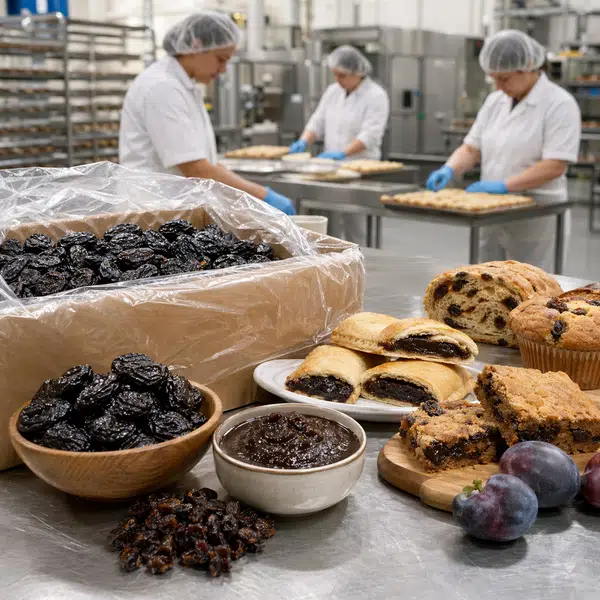
Bakery use is not one category. The technical and commercial requirements change sharply depending on whether prunes are used as a filling, a visible inclusion or a processed fruit ingredient.
Prunes are a valuable bakery ingredient because they offer natural sweetness, a dense fruit profile, dark color, soft texture and strong compatibility with a wide range of baked products. They can be used in pastry fillings, fruit breads, breakfast bars, cookies, muffins, cakes, bakery snacks and laminated items where manufacturers want recognizable fruit character with a rich eating experience. In many formulations, prunes also help build a more premium sensory profile than lighter dried fruit inclusions.
From an industrial buying perspective, prune use in bakery is highly specification-dependent. A manufacturer producing filled pastries may need a stable processed fruit base with controlled spreadability and bake tolerance. A snack bar producer may need diced or chopped prune pieces with low smearing tendency and good piece definition. A cookie or cake manufacturer may focus more on moisture contribution, flavor balance and visual appearance after baking. Because of these differences, generic price requests often fail to produce comparable offers.
The right commercial discussion starts with end use. Is the prune component going into dough, between layers, inside a filled product or on top as a visible fruit inclusion? Will the fruit pass through mixing, extrusion, sheeting, depositor systems or thermal processing conditions that change its texture? Does the final product need a clean fruit identity or a more integrated fruit base? These questions shape the specification as much as the raw material itself.
For importers, private label buyers and industrial food manufacturers, prunes should therefore be evaluated as a bakery system ingredient rather than only as a dried fruit commodity. The technical format, moisture balance, cut behavior, filling performance, handling properties and consistency of supply all influence whether the product will work commercially at scale.
Industrial demand typically falls into several practical use categories, each with different technical expectations.
Prunes are widely suited to pastry products where a fruit filling needs a dark, rich and naturally sweet profile with stable bake performance and good deposit behavior.
Diced or chopped prunes can be used in sweet breads, morning buns and enriched bakery products where manufacturers want visible fruit pieces and soft bite retention.
Depending on the recipe, prunes may function as inclusions or as part of a soft fruit center, particularly in premium or fruit-forward cookie concepts.
Prunes can support bar applications where dense fruit texture, natural sweetness and chewiness are required in combination with cereals, nuts or seeds.
Used either as pieces or processed fruit components, prunes can contribute moisture, fruit identity and a more indulgent flavor profile in soft bakery products.
Prunes may also be relevant in savory-sweet or wellness-positioned baked snacks where fruit content helps create a differentiated texture and value proposition.
The correct prune format depends on whether the bakery line needs flowability, deposit performance, visible inclusions or processed fruit functionality.
Relevant for selected artisanal or specialty bakery formats, or for customers who perform further cutting, blending or filling preparation in-house. Whole fruit offers strong visual identity but is less common in highly automated inclusion systems.
Often preferred for dough inclusions, bar applications and bakery mixes where piece consistency, portion control and even distribution are important. Diced fruit supports more predictable scaling in industrial production.
Used where a more natural irregular appearance is preferred, especially in bakery products with rustic or premium visual positioning. Buyers still usually define an acceptable cut range and tolerance for fines.
Suitable for filling systems, layered bakery products and fruit centers where the processor needs a spreadable or depositable fruit phase rather than visible individual pieces.
Industrial buyers sometimes request a custom cut or processed profile based on depositor design, bake conditions, target water activity approach, fruit inclusion ratio or desired mouthfeel in the final product.
For regular manufacturers, prune supply is often structured as a bulk ingredient program matched to line behavior, internal QA approval and recurring shipment needs rather than one-off procurement.
Industrial suitability depends on how the fruit behaves before baking, during processing and in the finished product over shelf life.
Moisture management is critical in bakery. Fruit that is too moist may smear during mixing, distort piece definition or interfere with dough handling. Fruit that is too dry can lose the soft bite and rich texture expected in premium bakery products.
For diced and chopped formats, piece integrity matters because excessive fines, crushed material or paste-like smearing can reduce visual quality and processing efficiency.
Prunes used in fillings or inclusions should retain acceptable texture, appearance and flavor after exposure to the intended baking profile. This is especially important in filled pastry and fruit bakery systems.
Bakery processors often evaluate whether the fruit can move cleanly through mixers, depositors, extruders or sheeting processes without bridging, smearing or losing structure.
A repeatable flavor profile is important because bakery recipes are usually calibrated carefully. Variability in prune sweetness or fruit intensity can affect finished product balance from batch to batch.
In premium bakery lines, fruit appearance remains important even after baking. Color consistency, visible fruit presence and low surface burn or deformation risk can influence consumer perception.
One of the most commercially important prune applications is fruit filling, where performance depends on more than fruit quality alone.
Prunes are especially relevant in bakery fillings because they provide a naturally dense, dark and rich fruit profile that fits pastries, filled cookies, layered products, bars and certain regional bakery specialties. In these applications, the key question is not only fruit origin or grade, but whether the filling system remains stable during processing and after baking. Manufacturers usually assess spreadability, deposit control, bake stability, flavor retention and finished texture in relation to their specific production line.
For filling use, buyers often need a more processed prune format such as puree, paste or a structured fruit preparation. The commercial discussion then shifts from raw dried fruit appearance toward functional bakery performance. Issues such as seed control, texture smoothness, consistency of solids, pumpability or depositor compatibility may become more relevant than whole-fruit presentation. This is why bakery filling inquiries are usually more detailed than general dried fruit purchasing inquiries.
A well-designed bakery filling program also considers the finished product shelf objective. Some customers want a soft fruit center that stays tender over time, while others need a more stable structure with cleaner slicing or portion control. The right supply program therefore depends on bakery category, process temperature, desired mouthfeel and commercial positioning of the final product.
Inclusions are chosen for both eating quality and visual appeal, but they must also survive industrial handling.
When prunes are used as visible bakery inclusions, the main challenges are distribution, piece retention and handling cleanliness. Dough and batter systems can stress fruit differently depending on shear level, hydration, proofing and bake conditions. A prune piece that works well in a soft breakfast bar may not behave the same way in a cookie dough or muffin batter. Because of this, industrial buyers usually validate cut size and texture against the actual process rather than approving only from a technical sheet.
For inclusions, the fruit should be soft enough to give a pleasant bite but not so sticky that it collapses into the dough matrix or creates uneven pockets. In many bakery lines, the supplier and buyer discussion focuses on balancing softness, piece definition and manageable surface tack. This practical balance often determines whether the ingredient scales successfully in full production.
Industrial bakery procurement is usually shaped by line performance, specification discipline and continuity of supply.
Serious bakery buyers usually request quotations based on defined use cases such as filling, diced inclusion or processed fruit component rather than a generic prune offer.
Annual or seasonal volume expectations help build a more stable sourcing plan and reduce procurement uncertainty around recurring bakery production schedules.
Bakery factories often evaluate how the fruit will be received, opened, stored and fed into production, so packaging format is commercially relevant from the start.
Documentation, compliance and labeling expectations differ across markets, so the final destination should be known before the quotation is finalized.
Initial bakery approvals commonly require pilot trials because process fit cannot always be confirmed from a specification sheet alone.
Recurring bakery products benefit from continuity in raw material profile and supply structure. Frequent changes in fruit behavior can create reformulation and QA burdens.
Packaging should support ingredient protection, factory handling and the commercial realities of international shipment.
Common for industrial bakery users that require hygienic, stackable and warehouse-efficient pack formats for recurring ingredient intake.
Useful for specialty manufacturers, regional distributors or bakery ingredient consolidators that do not consume full large-scale bulk units at the same rate as major factories.
Industrial buyers often need advance agreement on palletization, carton markings, lot coding and destination-specific label details for smoother receiving operations.
For prune ingredients used in bakery, logistics planning matters because soft fruit products can respond to storage temperature, transport time and handling conditions. Even when the fruit itself is technically acceptable, unsuitable pack structure or insufficient logistics planning can increase clumping, deformation or handling inefficiency on arrival. Buyers should therefore review shipment rhythm, lead times, warehouse conditions and inbound material handling together with the product specification.
Industrial bakery customers usually need a clear approval framework before onboarding a new prune supplier or format.
The product specification should define format, pitted status, cut style where relevant, sensory expectations, packing format and practical tolerance logic for industrial use.
For ready-to-eat bakery categories and fruit fillings, microbiological expectations should be aligned with the product type, target market and internal QA system.
Reliable lot identification and shipment traceability support quality assurance, complaint handling and recall discipline in modern bakery supply chains.
Some bakery programs require conventional supply, some organic supply, and some private label programs may need additional customer-specific documentation or approval procedures.
Manufacturers usually select prunes when they want a richer fruit proposition than a standard sweet inclusion can provide.
Prunes offer depth of flavor and a darker fruit character that can strengthen premium bakery positioning in pastries, bars, cookies and cakes.
The fruit supports a dense, moist and satisfying bite in many bakery systems, especially those targeting indulgent or fruit-forward textures.
In selected recipes, prunes can help round out sweetness perception and contribute to a more naturally framed ingredient story.
Prunes can be supplied as inclusions or as processed fruit bases, giving product developers flexibility across multiple bakery categories.
Many sourcing problems come from incomplete application definition rather than from the ingredient itself.
Requests without clear end use often lead to non-comparable offers because inclusion-grade fruit and filling-grade fruit are not the same commercial product.
Fruit that is too soft or too dry for the bakery system can create waste, process instability or reduced finished product quality.
Skipping line trials can lead to later issues in depositing, mixing, slicing, bake stability or finished shelf performance.
A cheaper prune offer may become more expensive in actual use if it causes smearing, poor deposit control, inconsistent appearance or higher rejection rates.
Even technically sound fruit can create warehouse and production issues if pack format does not match factory handling needs.
Bakery manufacturers usually need repeatable fruit behavior. Large variation across lots can create reformulation pressure and quality concerns.
A practical prune inquiry becomes much easier to quote when the buyer shares the right technical and commercial points at the start.
Confirm whether the requirement is for filling, diced inclusion, chopped fruit, puree or another application-specific prune format.
Share target texture, preferred piece size, bake conditions, process route, microbiological expectations and any critical handling concerns.
Clarify volume, pack format, destination market, certification requirement, trial quantity and whether the project is spot, recurring or contract-based.
These are the points that usually matter most for industrial bakery buyers.
Bakery fillings, dough inclusions and snack bar applications all require different prune profiles, so the application must be fixed before comparing offers.
The correct moisture and softness balance affects depositor behavior, mixing cleanliness, piece retention and final eating quality.
In bakery manufacturing, line efficiency and finished product consistency often matter more than nominal price differences between offers.
Forecast-based supply planning generally supports better continuity than short-term spot buying, especially for recurring bakery lines.
Short answers for importers, bakery processors and product developers.
Buyers should clarify end use, required format, whether the fruit is for filling or inclusion, target texture, certification profile, microbiological expectations, pack format and annual volume.
Because prune requirements differ significantly between fillings, dough systems, bars, cookies, cakes and pastries. Each bakery application has different process, moisture, texture and commercial expectations.
Whole pitted prunes, diced prunes, chopped prunes, puree and paste-style filling bases are all relevant depending on the product design and the manufacturing process.
In many cases yes, provided the fruit, certification profile and processing route are aligned with the customer requirement and the available sourcing program.