Prunes

Prunes: Container Loading, Transit and Storage Advice

A practical logistics guide for importers, distributors, repackers and food manufacturers evaluating how prunes should be loaded, shipped, received and stored to protect quality and reduce avoidable commercial risk.

Logistics FocusLoad to warehouse
Risk ControlTransit protection
Buyer ViewCommercial continuity
Prunes: Container Loading, Transit and Storage Advice

Why this topic matters

For prunes, logistics execution is part of product quality, not a separate issue.

Prunes are a shelf-stable dried fruit, but that does not mean they are logistics-insensitive. Their natural sugar content, soft structure and moisture profile mean that loading conditions, packaging integrity, transit exposure and warehouse handling can materially influence how the product arrives and how it performs later in retail, repacking or industrial use. A shipment can leave in sound condition yet create avoidable issues if container loading, transit planning or storage discipline are weak.

In commercial practice, prune quality is shaped not only by fruit grade and packing format but also by how the goods are palletized, how the container is prepared, whether the load is protected against heat and condensation, and how quickly the goods are rotated after arrival. These details matter for importers because complaints are often linked less to the fruit itself than to packaging damage, stickiness increase, compression, carton weakening, odor pick-up or poor storage after discharge.

For that reason, buyers should not view container loading and storage advice as an operational afterthought. It is part of the total sourcing decision. The same prune specification may perform well on one route and poorly on another if climate, transit duration, warehouse conditions or handling discipline differ. Strong logistics alignment helps reduce claims, preserve usable shelf-life and support repeatable supply programs.

Atlas treats logistics as part of commercial fit. Pack type, destination, transit season, warehouse profile, target shelf period and end use all influence how prune shipments should be prepared and managed.
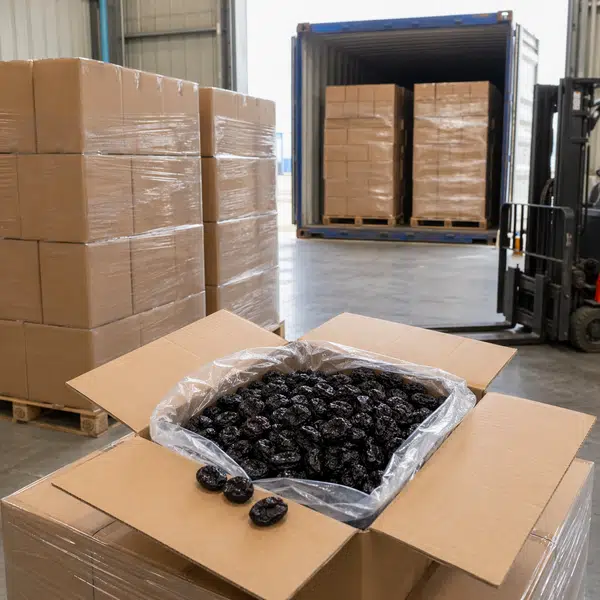
Why prunes need careful logistics handling

Understanding the physical behavior of the fruit helps explain why loading and storage details matter so much.

Moisture-sensitive product behavior

Prunes are stable when packed and stored correctly, but they still respond to changes in surrounding conditions. Excess heat, poor ventilation or moisture migration can alter surface feel, internal softness and pack appearance.

Soft fruit under compression

Because prunes are dense but pliable, weak carton performance or poor pallet stacking can increase deformation, pack stress and presentation loss during longer shipments.

Packaging dependence

The fruit depends heavily on pack quality. Inner liners, outer cartons, seal integrity and pallet wrap all contribute to how well the goods tolerate movement, storage and climate variation.

Channel-specific expectations

Retail and private label programs often have stricter arrival expectations than industrial programs. The same transit issue may be tolerable in one channel and commercially unacceptable in another.

Container loading priorities

Good loading practice protects both the fruit and the shipment economics.

Clean and odor-free container

The container should be dry, structurally sound and free from residual odors, moisture problems, chemical traces or contamination risks. Prunes can pick up unwanted odors if the container environment is unsuitable.

Dry interior condition

The loading environment should be dry before stuffing. Residual moisture or wet flooring creates avoidable risk for carton weakening, liner exposure and later condensation-related issues.

Pallet stability

Pallets should be stacked evenly and secured well enough to reduce movement during inland transport, terminal handling and sea transit. Poorly built pallets increase collapse and compression risk.

Carton strength alignment

Outer cases should match the expected stacking load and transit duration. A carton that performs adequately in short domestic handling may not be suitable for export container conditions.

Load distribution

Weight should be distributed evenly within the container to improve handling stability and reduce strain on lower pallet layers. Uneven loading can contribute to freight damage and handling inefficiency.

Airflow and spacing logic

Depending on route and season, buyers may prefer loading logic that avoids unnecessary compression against container walls and supports a more stable internal environment during transit.

Transit risks buyers should understand

Most prune shipment problems are not random. They follow a few recurring logistics patterns.

Transit risk for prunes usually centers around heat exposure, condensation, packaging failure, pallet instability and delayed handling after arrival. On long routes or during warmer periods, elevated temperatures can soften the fruit further, increase tackiness and place more stress on packaging. If cartons or pouches are not well matched to the product and journey, the result can be compression, distorted presentation or outer-case weakness.

Condensation is another key concern in international dried fruit shipments. Sudden temperature shifts between production, port storage, sea transit and inland warehousing can create moisture-related problems that affect both packaging and product condition. Even when the fruit remains safe and usable, visual deterioration or sticky pack presentation can create a commercial issue, especially in retail-oriented programs.

There is also a commercial timing risk. A shipment that arrives correctly still needs disciplined discharge, warehousing and rotation. Delays at destination, prolonged container dwell time, poor unloading conditions or improper storage after receipt can reduce the practical shelf-life advantage that buyers expected when they placed the order.

Temperature and moisture considerations

Prunes do not usually require refrigerated transport in standard trade programs, but they do require sensible control of heat and humidity exposure.

Heat exposure

Extended high-temperature exposure can affect fruit firmness, surface tack, internal consistency and pack presentation. This matters especially for consumer-facing programs and long transit routes.

Condensation risk

Rapid temperature changes can contribute to moisture accumulation inside the logistics chain. Condensation can weaken cartons, affect labels and create unwanted presentation changes even if the fruit remains merchantable.

Moisture migration

If packaging barrier performance is weak or warehouse conditions are unstable, the product may experience moisture shifts that affect eating quality, handling characteristics and line behavior after arrival.

Route-specific planning

Shipment season, destination climate and expected dwell times should be considered when selecting packaging strength, pallet protection and loading approach. A one-size-fits-all logistics method is not always appropriate.

Palletization and unit load advice

Good pallet build quality reduces damage risk and helps importers handle the cargo more efficiently after arrival.

Uniform case stacking

Cartons should be stacked in a consistent pattern that balances stability with compression control. Irregular stacking can increase pallet sway and outer-case damage.

Appropriate pallet height

Overly tall pallet builds may create instability or excess weight on lower cartons. Pallet height should align with carton strength, transport route and warehouse handling practice.

Stretch wrap discipline

Wrapping should secure the unit load without creating excessive inward pressure that distorts cartons or reduces stack integrity over time.

Corner and edge protection

Where needed, protective components can help maintain pallet shape and reduce case damage during repeated movement through ports and warehouses.

Pallet condition

Pallets themselves should be sound, clean and suitable for export. Damaged pallets create avoidable handling and load security issues later in the chain.

Receiving efficiency

Well-built pallets not only survive transit better, they also speed up unloading, warehouse placement and stock control at destination.

Warehouse storage advice after arrival

Arrival condition can deteriorate quickly if destination storage practice is poor.

After discharge, prunes should be moved into a clean, dry and temperature-managed storage environment appropriate to the packaging format and intended shelf period. Warehouses should avoid excessive heat, direct sunlight, high humidity, unstable conditions or proximity to odor-active goods that may affect the product. For consumer-ready packs especially, packaging appearance can be influenced by storage discipline just as much as the fruit itself.

Pallets should be stored in a way that prevents crushing, unnecessary re-stacking stress or contact with unsuitable surfaces. Good warehouse rotation is essential. Importers should manage stock on a first-in, first-out or similarly disciplined basis so the product moves through the system according to arrival date and remaining commercial shelf-life. Holding product too long under weak storage conditions creates unnecessary claim exposure and reduces pack performance at point of sale.

Warehouse teams should also inspect cargo on arrival for visible carton damage, moisture signs, pallet movement or seal issues. Early identification makes corrective handling easier and improves communication across the supply chain if any issue needs escalation.

Retail, foodservice and industrial implications

The same logistics event can have different consequences depending on the final application.

Retail and private label programs

These programs are usually the most sensitive to appearance-related transit issues. Carton weakness, label damage, pack distortion or sticky presentation can create immediate commercial concern even if the fruit remains usable.

Foodservice channels

Foodservice users may place more emphasis on practical usability, but they still need clean packaging, reliable handling and product consistency after opening and storage.

Industrial users

Industrial programs may tolerate a broader visual range, but packaging failures, moisture changes and warehouse mishandling can still affect process yield, cutting behavior and operational efficiency.

Repacking operations

Importers who repack locally need especially stable inbound logistics because their process efficiency depends on cartons arriving intact, traceable and easy to handle on the line.

Packaging and logistics work together

Transit performance depends on the combination of fruit, packaging and route, not on any single factor alone.

Inner liner protection

Food-grade inner liners help isolate the fruit from the outer case environment and support hygiene, containment and product release behavior.

Outer case performance

Corrugated carton quality matters in stacking, container stuffing and destination handling. Weak outer cases increase both physical damage and claim risk.

Seal integrity

Seals on pouches, liners or consumer packs should remain reliable through transit and storage. Seal failure can compromise both appearance and practical usability.

Pallet wrap and restraint

Load stabilization materials should be selected and applied in a way that supports the shipment rather than adding distortion or heat-related stress to the pack.

Case marking and traceability

Clear outer-case identification helps with unloading, stock rotation, warehouse placement and any later investigation into logistics performance.

Program-specific design

Long transit routes, warm destinations or sensitive retail programs may justify stronger packaging and tighter logistics controls than simpler regional bulk business.

Commercial factors that influence logistics planning

Transit advice should be matched to the actual commercial structure of the program.

Container loading and storage planning for prunes usually depends on destination market, shipment season, transit duration, packaging format, carton strength, annual volume, insurance exposure, arrival handling capability and final channel requirements. A buyer shipping bulk product for industrial use may accept a different risk profile from a buyer shipping shelf-ready private label consumer packs into a demanding retail environment.

Program continuity also matters. Buyers with annual or structured repeat volumes can usually plan packaging, palletization and dispatch windows more effectively than those purchasing only occasionally on a spot basis. The more clearly the shipment rhythm and warehouse profile are known in advance, the easier it becomes to structure a reliable logistics solution.

From a commercial perspective, logistics discipline helps protect not only the product but also landed cost efficiency. Avoided claims, smoother unloading, less rework, better pallet handling and stronger stock rotation all contribute to a healthier total supply program.

Buyer checklist before shipment

These points help importers and suppliers align on a more reliable logistics brief.

Product and pack format

Confirm whether the prunes are bulk, foodservice, retail or private label packed, and whether the program is pitted or unpitted, since this affects packaging sensitivity and arrival expectations.

Route and season

Share the destination, expected transit duration and shipment season so load planning can reflect realistic climate and handling conditions.

Warehouse profile

Clarify whether the receiving warehouse is temperature-managed, fast-turn, long-hold or part of a repacking operation. Destination conditions matter greatly after arrival.

Channel sensitivity

State whether the product is destined for premium retail, mainstream retail, foodservice or industrial processing, because claim sensitivity differs significantly by channel.

Pallet and case expectations

Confirm pallet format, maximum height, outer-case requirements, barcode logic and any customer-specific unloading rules before dispatch.

Post-arrival handling plan

Make sure the receiving side is prepared to inspect, unload, store and rotate the product correctly as soon as the shipment is released.

Key takeaways

These points make prune logistics planning more practical and more commercially reliable.

Prunes are shelf-stable, not logistics-proof

Even stable dried fruit can be affected by poor loading, heat exposure, condensation, weak cartons and poor storage practice.

Container preparation matters

Dry, clean, odor-free containers and stable pallet loading reduce avoidable transit risk from the start.

Transit conditions affect arrival quality

Heat, moisture shifts and poor pallet security can influence pack appearance, fruit handling properties and claim risk on receipt.

Warehouse discipline protects shelf-life

Prompt unloading, dry storage, sensible temperature control and good stock rotation are essential after arrival.

Channel determines sensitivity

Retail and private label programs usually require tighter logistics control than bulk industrial programs because arrival presentation is more commercially important.

Better logistics support better trade

Good loading and storage practice reduce claims, protect margins and improve continuity across repeat prune supply programs.

Mini FAQ

Short answers to the most common questions around prune loading, transit and storage.

What should buyers clarify first for prune logistics programs?

Buyers should first clarify the product format, pack type, shipment season, target market, storage conditions after arrival, transit expectations and whether the program is bulk, foodservice, retail or private label.

Why is separate guidance needed for container loading, transit and storage?

Because prunes are sensitive to moisture balance, temperature exposure, carton strength, pallet stability and warehouse handling conditions, all of which can affect arrival quality and claim risk.

What are the main logistics risks for prunes in shipment?

The main risks include moisture migration, temperature stress, packaging damage, pallet movement, condensation, odor contamination and poor warehouse rotation after arrival.

Do prunes need special storage after arrival?

They should be stored in a clean, dry and appropriately managed warehouse environment away from excessive heat, unstable humidity and odor-active goods, with disciplined stock rotation.

Why does pallet quality matter so much?

Because stable pallets reduce carton collapse, shifting, unloading damage and handling inefficiency throughout the logistics chain.

Can this topic support both organic and conventional programs?

In many cases yes, provided the fruit, packing system, storage conditions and documentation profile are aligned with the required organic or conventional supply program.

Quick Contact