Application comes first
The right dried sour cherry specification depends on whether the fruit is intended for retail, bakery, confectionery, cereal, dairy inclusion, chocolate coating, further cutting or ingredient blending.
A practical trade and application guide for importers, processors, distributors and private label buyers evaluating dried sour cherries by size range, moisture, defects, packing format and commercial fit.
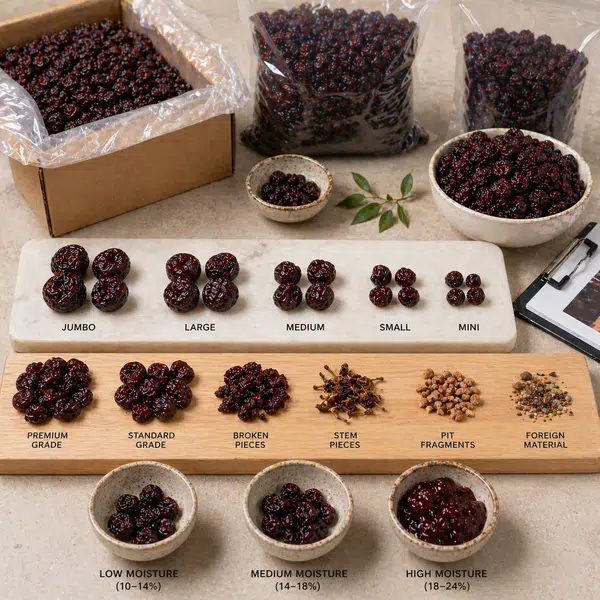
Dried sour cherries are not a one-specification item. Commercial success depends on matching the product profile to the intended use.
Dried sour cherries occupy a specialized position within the dried fruit category because they combine distinctive tartness, natural fruit character, visual appeal and functional use across several food segments. They are used in bakery fillings, cereal blends, chocolate applications, snack mixes, bars, confectionery, toppings and premium retail packs. That broad usability makes them commercially attractive, but it also means that one generic description is rarely enough for a serious quotation or annual supply discussion.
From a buyer perspective, the key issue is that dried sour cherries can vary substantially in size definition, moisture condition, sweetness level, surface texture, color tone, stem tolerance, pit tolerance, cut or broken fruit ratio and overall visual uniformity. Some customers want a clean and visually attractive fruit for consumer-facing packaging. Others care far more about processing behavior, water activity management, cutting performance, mixing stability or flavor release inside a finished formulation. These differences should be translated into a written product brief before price comparisons are made.
In commercial practice, dried sour cherries are often discussed with terms such as premium grade, industrial grade, selected grade, sweetened or unsweetened, jumbo or standard size, but those labels alone do not create a reliable specification. Serious buyers typically define the acceptance range for moisture, foreign material, defects, microbiological profile, packaging system, document set and certification scope. This is especially important when the product is intended for export programs, private label packing or industrial production lines where consistency matters more than a one-time spot price.
For this reason, a good technical and commercial discussion should not start with price alone. It should start with application, expected fruit appearance, desired taste profile, processing needs, target market compliance and pack configuration. Once those points are aligned, a supplier can build a more accurate and more competitive offer with fewer revisions and less execution risk.
These points make the article immediately useful for sourcing teams, technical buyers and product developers.
The right dried sour cherry specification depends on whether the fruit is intended for retail, bakery, confectionery, cereal, dairy inclusion, chocolate coating, further cutting or ingredient blending.
Terms like premium or standard are not enough on their own. Size band, moisture range, defect tolerance and surface condition should be stated clearly.
Lower moisture, better color sorting, tighter defect control, improved pit management and stronger packaging systems can all affect final pricing and suitability.
Buyers with regular requirements usually obtain better planning support when they share forecasted volume, pack type, shipment rhythm and documentation needs in advance.
Commercial classification normally combines application logic with appearance and process expectations.
These normally emphasize more uniform appearance, stronger size consistency, attractive color, lower visible defects and pack presentation suitable for branded or private label channels.
These are often selected for flavor impact, workable moisture, manageable stickiness and decent size consistency while allowing a more practical visual tolerance than premium retail fruit.
These grades are typically specified around process performance, economics and fit-for-use standards, including cut tolerance, moisture behavior, microbiological compliance and defect limits aligned to the final application.
In some programs, further differentiation is made between whole fruit, selected whole fruit, cut fruit, chopped ingredient grade or inclusion grade for bars, cereals and fillings. Sweetened and unsweetened profiles may also be separated because they behave differently in formulations and produce different nutritional declarations and label claims. Organic and conventional programs can both follow similar technical logic, but the compliance and certification dimension must be defined separately.
Size is one of the first visible attributes buyers evaluate, but it should be interpreted in relation to end use rather than appearance alone.
Larger fruit is usually preferred for premium snack packs, chocolate enrobing, visible bakery decoration and premium mixes where visual impact contributes directly to market positioning. This type of fruit may command stronger pricing because selection losses are higher and pack appearance matters more.
Standard size fruit is often appropriate for mainstream bakery, cereal, granola, snack mix and food service channels. It provides a balance between acceptable visual consistency and competitive cost.
Smaller fruit or mixed size programs may still be commercially suitable for fillings, bars, chopped use, industrial blending and applications where fruit visibility is secondary to taste and cost control.
Different processors and markets may use different classification language, so a buyer should request the exact size logic being offered rather than relying only on general labels such as jumbo, medium or standard.
When size matters, buyers should ask whether the specification is controlled by visual grading, processing selection, approximate count logic, sieve-style separation where applicable, or simply by a broad commercial description. For consumer-facing or premium industrial programs, it is often useful to approve a pre-shipment reference sample so both sides work to the same visual expectation.
The following parameters are among the most important when converting a sourcing conversation into a usable purchase specification.
Moisture influences chewiness, softness, clumping tendency, process handling, microbiological stability and shelf-life behavior. A lower-moisture program may support freer flow and easier handling, while a softer program may be preferred for direct eating or specific bakery applications.
Color expectations vary by origin profile, drying method, sweetening system and crop conditions. Retail and premium mix buyers often request stronger uniformity, while industrial users may prioritize flavor and process fit over exact visual matching.
Dried sour cherries may be evaluated for tartness, overall fruit intensity, sugar balance, residual acidity and clean finish. The desired profile depends heavily on whether the fruit is consumed alone or integrated into a sweet finished product.
These are critical control points. Buyers should clarify accepted levels for stems, pit fragments or residual foreign material and align them with the risk profile of the final market and application.
Some processes naturally produce a proportion of broken fruit. The acceptable limit depends on whether the application values appearance or simply functional inclusion.
Visual sorting, metal detection, foreign matter control and line discipline are part of the product value. Higher sorting standards normally support higher value channels.
Not every program requires the same detail, but these are common points in technical reviews and supplier qualification discussions.
Usually discussed as an agreed operating range rather than a vague statement such as soft or dry. This affects handling, shelf life and process behavior.
For some industrial uses, especially where the fruit is combined with other inclusions or packed in controlled shelf-life formats, water activity management can be commercially relevant.
Customers may require routine microbiological compliance aligned to their market, customer code or finished product application.
Organic, conventional, specific market compliance or customer-specific testing programs should be clarified at inquiry stage rather than after pricing.
This affects taste, label declaration, nutritional panel positioning, process stickiness and suitability for certain product claims.
Required remaining shelf life on arrival, packaging barrier expectations and storage recommendations should be aligned early for export shipments.
It is good practice for buyers to specify whether they need a standard product data sheet, a more detailed technical specification, allergen statement, non-GMO declaration where relevant, packaging declaration, certificate profile or testing plan. The more disciplined the specification stage is, the more stable the commercial program usually becomes.
These examples illustrate how the same product category may be positioned differently depending on the sales channel.
This segment usually expects visually attractive fruit, relatively cleaner presentation, more uniform size, controlled defect tolerance, dependable packaging integrity and label-ready documentation. Carton presentation, consumer pouch filling performance and market claim compatibility may all matter.
Here the focus often shifts toward flavor intensity, moisture balance, manageable stickiness, inclusion stability and cost-performance balance. Uniformity remains important, but visual perfection may be less critical than processing reliability.
Fruit size, surface dryness, flavor contrast and handling behavior become important. Buyers may request tighter selection if the fruit remains visible or if it is used for premium coated applications.
For chopped fruit, fillings, compounds or blended ingredient systems, the economics may favor a practical specification with carefully controlled safety and usability parameters rather than premium cosmetic selection.
Packaging affects freight efficiency, shelf-life protection, warehouse handling and line use at destination.
Commonly discussed in lined cartons or other bulk export formats for processors and repackers. The exact net weight, bag construction and palletization pattern should be agreed in advance.
Suitable for distributors or intermediate users who require manageable pack sizes for onward handling. Labeling and carton durability are usually more important here.
These programs require a more integrated discussion around pouch type, barrier properties, coding, artwork workflow, case pack, pallet efficiency and destination compliance.
For export programs, buyers should also clarify whether they require palletized or floor-loaded shipments, whether special liner materials are needed, whether the product should be packed under a particular hygiene protocol and what labeling details must appear on unit packs and master cartons. These points may look operational, but they affect the final commercial offer and shipment readiness.
Pricing depends on much more than crop availability. Specification strictness and execution requirements materially affect the offer.
Seasonal conditions can influence fruit size distribution, color, acidity, availability and the yield required to build tighter grades.
More demanding requirements for appearance, low defects, tighter pit control or better color consistency usually increase processing cost and reduce yield.
The product profile itself can change raw material usage, handling behavior, formulation economics and the type of customer it can serve.
Organic certification, special testing requests, customer-specific documentation and additional controls can influence final pricing and lead time.
Bulk cartons, inner liners, retail pouches, branded labels, private label preparation and pallet configuration all affect cost structure.
Forecast visibility, contract duration and shipment regularity often help support better production planning than isolated spot requests.
A more complete inquiry usually produces a more accurate and commercially useful offer.
Confirm whether you need sweetened or unsweetened fruit, preferred size style, visual grade, target moisture behavior and whether the fruit must remain whole or can include a limited percentage of broken pieces.
State required documents, certification status, microbiological expectations, residue or testing requirements and whether sample approval is necessary before shipment.
Specify annual volume estimate, trial quantity, shipment frequency, destination market, incoterm preference and whether the inquiry is spot, seasonal or annual program based.
Clarify inner bag type, outer carton style, unit weight, retail pouch requirement, palletization expectations and labeling language or barcode needs.
Explain whether the fruit is used in bakery, cereal, chocolate, snacking, topping, blending or industrial transformation so the proposed grade matches the real use case.
Share whether your company requires benchmark samples, specification sign-off, supplier questionnaire review or audit-related documents before order confirmation.
Many delays and misunderstandings come from incomplete specification language rather than actual supply problems.
Two offers may look different because they are not describing the same fruit quality, moisture, packing system or certification scope.
Terms like best quality or premium should be backed by measurable or reviewable criteria so that production and receiving teams work against the same expectation.
A fruit suitable for ingredient blending may not be suitable for premium retail, and a retail-focused specification may be unnecessarily expensive for industrial use.
Packaging changes can affect lead time, costing, documentation, labeling and even product condition on arrival.
Atlas aims to structure dried fruit conversations around fit, specification clarity and realistic export execution.
Atlas Global Trading Co. supports buyers by translating broad product requests into usable commercial frameworks. For dried sour cherries, that means clarifying the application, helping distinguish between appearance-led and process-led requirements, aligning the certification profile, reviewing packing expectations and preparing an offer that reflects the real supply brief rather than a generic market headline. This reduces revision cycles and helps both sides move faster from inquiry to shipment planning.
Where relevant, Atlas can support discussions around organic and conventional programs, bulk and private label supply, documentation flow and practical shipment planning from Turkey. The goal is not simply to quote a price, but to help buyers define a purchaseable specification that supports continuity, compliance and realistic cost control.
Short answers for importers, food manufacturers and sourcing teams reviewing the category quickly.
End use, target market, desired grade, sweetness or acidity profile, required certification profile, moisture preference and preferred pack format should be clarified first.
They are usually differentiated by intended application, fruit size range, moisture level, color uniformity, defect tolerance, sweetened or unsweetened profile, certification status and packaging format.
Because moisture, cut tolerance, defects, sweetening profile, packaging style, microbiological expectations and documentation scope can all materially change the offer and the final delivered value.
In many cases yes, provided the fruit, process controls and certification profile are aligned with the customer requirement and the available sourcing program.
No. Larger fruit may be preferable for premium visible applications, but standard or mixed size grades may be more efficient and fully suitable for industrial, chopped or blended uses.
A useful inquiry usually includes target application, expected quality level, preferred pack format, estimated volume, certification requirements, destination market and shipment frequency.
Buyers reviewing dried sour cherries often also compare adjacent category decisions.
Certification scope, supply planning, customer positioning and testing expectations can materially change the sourcing strategy.
The product may be the same category, but the operational and documentation requirements can be very different.
Annual planning usually improves continuity, packaging coordination and shipment predictability compared with opportunistic spot buying.