Certification alignment
The product and the supplier documentation should match the buyer’s required certification route, whether the requirement is organic or conventional with channel-specific controls.
A practical compliance and trade guide for dried mulberries covering certification profiles, buyer qualification expectations, shipment documents, label support and the documentation structure needed for smoother international supply programs.
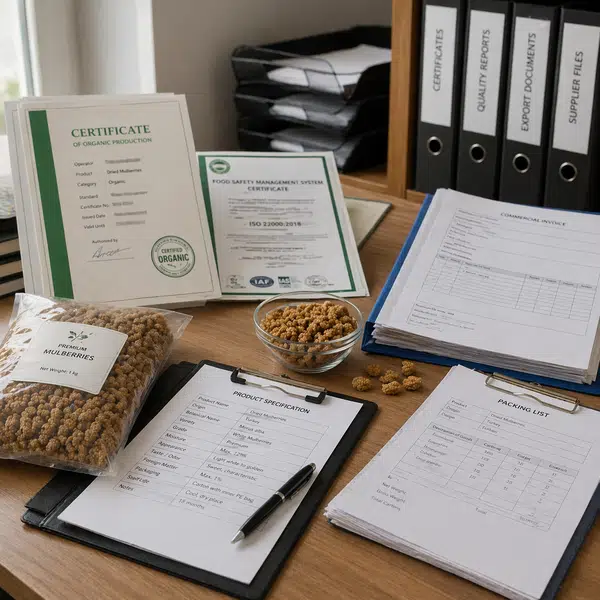
In international dried fruit trade, a product is not commercially complete until its certification profile and documentation are aligned with the buyer’s market and channel.
Dried mulberries can be sold into premium retail, foodservice, repacking, private label and industrial ingredient channels. Each of these routes may have different expectations for certifications, compliance evidence and shipment documentation. Because of that, buyers should not treat documentation as a last-minute export formality. In practice, documentation is part of the product offer itself.
A dried mulberry program can be technically suitable and commercially attractive, yet still become difficult if the required certification scope, declarations, label support or shipment paperwork are not aligned from the start. This is especially true when the product is intended for organic channels, branded retail, private label, specialist importers or customers with formal supplier onboarding systems.
For serious buyers, the main question is not simply whether documents can be issued. It is whether the overall compliance profile supports the intended use and market. The stronger the alignment between the product, the pack format, the certification profile and the supporting documents, the easier it becomes to move from quotation to approval, shipment and repeat business.
That is why certification, compliance and documentation deserve a separate discussion. A smoother trade program is built when buyers define the exact market, channel, product format and required document set before commercial negotiation moves too far ahead.
Compliance is broader than one certificate. It combines product identity, documentation accuracy and market-fit support.
The product and the supplier documentation should match the buyer’s required certification route, whether the requirement is organic or conventional with channel-specific controls.
Compliance also includes whether the shipment documents and declarations reflect the actual agreed product, pack format and program structure.
Many buyers need a practical document set that helps them clear the goods, onboard the supplier internally and release the product into their own channel confidently.
For retail and private label programs, compliance includes whether the packaging and supporting information remain aligned with the commercial and regulatory expectations of the target market.
The right certification profile depends on channel, market positioning and customer onboarding requirements.
These are relevant when dried mulberries are supplied into organic retail, specialist natural food channels, wellness-oriented ranges or customers who require organic identity throughout the program.
Conventional programs still require disciplined documentation, especially when the buyer needs a stable specification, repeat shipments and clear supplier qualification support.
Retail and private label customers may require additional document coordination because the product moves under a brand promise and often through more formal approval channels.
These may not always need the same packaging documentation depth as retail, but they still benefit from clear product identity, consistent shipment documents and dependable batch support.
Industrial users often focus on the practicality of product declarations, specification alignment and supplier reliability rather than retail-facing label structure.
Some buyers supply more than one channel at once. In such cases, the certification and documentation structure should be defined carefully to avoid confusion across retail, bulk and private label use.
Two offers that appear similar on price may not be equivalent if the document support and compliance readiness are different.
Buyers often compare offers by product description, origin and price, but documentation readiness can be just as important. A quotation is commercially stronger when the supplier can support the buyer’s real approval and shipment needs. This includes clear product identification, pack consistency, certification alignment and the ability to provide the documents the buyer expects for import and internal release.
Where the program involves retail, organic positioning, private label or customer-specific onboarding, the documentation burden often increases. In these cases, compliance support is not a secondary service. It is part of what makes the supply chain workable. If the supplier and buyer do not align on documentation early, delays and misunderstandings are much more likely later.
For that reason, the compliance brief should be discussed alongside the product brief. Buyers should not assume that all suppliers are quoting against the same level of document support, even if the base product appears similar.
The exact document set can vary by market and customer, but most serious programs depend on a core group of commercial and compliance documents.
A clear specification helps the buyer confirm that the offered dried mulberries match the intended grade, application and commercial expectation.
Where the program requires a certified route, buyers usually need confirmation that the supplier’s certification scope supports the intended transaction structure.
Basic trade documents remain essential because the shipment still needs to move cleanly through export and import processes.
Traceability support matters for both buyer confidence and internal stock control, especially in recurring or private label programs.
Retail and private label channels often require pack-level detail so the buyer can align the product with market-facing presentation and internal approval systems.
Some buyers need additional forms or declarations as part of onboarding, procurement compliance or brand-related approval processes.
For organic programs, the documentation flow and certification alignment must support the full commercial route, not just the product description.
Organic dried mulberry programs typically involve a higher level of documentation sensitivity because the buyer is not only purchasing fruit. They are purchasing an organic commercial identity that must remain consistent through supply, paperwork and channel presentation. This means the product, the pack, the documents and the intended sales route should all remain aligned.
Organic buyers often need early clarity on whether the supplier’s certification scope and document flow can support the intended market and transaction model. This is especially relevant in retail and private label programs where organic positioning is part of the product’s commercial value, not only a technical description.
As a result, organic program planning generally works best when certification and documentation needs are discussed before samples, labels or annual supply terms are finalized. That reduces the chance of delays later in the process.
Conventional supply may be simpler in some channels, but it still depends on clean paperwork and clear commercial alignment.
Conventional dried mulberry programs are sometimes assumed to be straightforward because they do not carry an organic certification claim. In practice, however, they still require structured documentation. Buyers still need the shipment to match the agreed specification, pack format and customer expectation. Distributors, repackers, ingredient users and foodservice importers all benefit from clear and consistent document support.
Where the product moves into branded, retail or customer-controlled channels, even conventional programs may require more formal supplier onboarding and pack-related review. This means that strong conventional supply is not defined by the absence of certification, but by the presence of orderly and dependable documentation.
The document set should reflect the actual commercial route and not be treated as one generic export bundle for every buyer.
Retail buyers usually need more visible alignment between product specification, pack format, label content and channel positioning, especially where the product will be sold under a consumer-facing brand.
Private label programs often require the highest document discipline because product, label, brand and shipment details must all remain tightly coordinated.
Industrial buyers often focus more on specification support, shipment accuracy and practical supplier qualification than on retail-facing artwork or shelf claims.
These customers usually need consistent identity, traceability and pack logic, but the exact documentation emphasis may be different from branded retail supply.
Compliance is not only about certificates and shipment papers. It also includes how the product is described and presented in the pack.
For retail and private label dried mulberries, pack and label consistency are commercially important because the buyer is not only importing a food product. They are introducing it into a market-facing packaging system. The product description, brand presentation, pack size and batch control logic should therefore be consistent with the wider document set.
Even when the buyer manages artwork directly, the supplier discussion should still cover label logic, carton identification, lot references and how the packed product will be documented across repeat orders. This is one of the key differences between a simple commodity shipment and a structured branded supply program.
Most documentation problems begin with unclear assumptions, not with the product itself.
The buyer should confirm the intended certification and documentation scope early instead of assuming all offers are commercially equivalent.
Import, onboarding, private label and label-related requirements should be discussed before the program is treated as final.
Certification and documents affect feasibility, timing and comparability, so they should be discussed alongside product and pack details.
Retail, industrial, repacker and foodservice buyers may need different emphasis in the supporting documentation structure.
When pack information and shipment support are not aligned, approval and market release can become more difficult than necessary.
Documentation should remain consistent across recurring shipments so the buyer does not need to restart approval work each time.
A structured compliance brief helps Atlas prepare a quotation that is commercially useful and operationally realistic.
Confirm whether the dried mulberries are intended for retail, private label, foodservice, repacking or industrial use.
State clearly whether the requirement is organic or conventional and whether the buyer has any defined certification or approval route to follow.
Define the grade, pack format and intended end use so the compliance structure matches the actual commercial product.
List any buyer-specific declarations, onboarding forms or market documents that affect approval and shipment readiness.
Clarify whether the program involves branded, plain or private label packs and whether label coordination is part of the requirement.
State whether the requirement is for a sample stage, trial order, recurring shipments or a longer annual supply program.
These points help buyers reduce approval delays and build more dependable dried mulberry programs.
Certification scope, declarations and shipment documents influence whether the supply program is practically workable.
The commercial structure becomes stronger when the certification profile is aligned at the beginning rather than assumed later.
Retail, private label, foodservice and industrial buyers often require different levels of packaging, label and onboarding support.
When buyers define the needed documents early, offers become more comparable, execution becomes smoother and repeat business becomes easier.
A short checklist helps buyers and suppliers move faster toward a practical certifications and documentation structure.
State the destination market and sales channel so the required compliance route can be understood clearly.
Confirm whether the requirement is organic or conventional and whether any specific program conditions apply.
Share the intended grade, pack format and use case so the documents match the actual commercial product.
List any import, onboarding, label or customer-specific document expectations at the start of the discussion.
Clarify whether the packs are plain, branded or private label and whether label coordination is required.
State whether the project is a trial, recurring order or annual program so the document flow can be planned appropriately.
Short answers help buyers review the compliance topic quickly before starting supplier approval or shipment planning.
Buyers should first clarify end use, target market, desired grade, certification profile, pack format, labeling scope and the documentation required for import, retail or industrial approval.
Because the commercial suitability of dried mulberries depends not only on product quality but also on whether the supplier can support the required certification scope, compliance profile, shipment documents and customer onboarding needs.
Yes. Both organic and conventional dried mulberry programs can be supported when the certification scope, product identity, document flow, labeling expectations and destination market requirements are aligned.
The main documentation points are product specification alignment, certification validity, traceability support, shipment documents, pack and label consistency, and any buyer-specific declarations needed for retail, foodservice, private label or industrial use.
Atlas supports buyers who need dried mulberry programs aligned with real certification, documentation and channel expectations.
If your project involves dried mulberries for organic retail, private label, repacking, foodservice or industrial use, the most useful next step is to share the target market, certification requirement, pack format, labeling scope and the document expectations that matter most for approval. That allows Atlas to structure the discussion around a commercially workable compliance route rather than a generic product offer.
Whether the requirement is for an initial qualification stage, a first shipment or a recurring annual program, a clear compliance brief usually leads to faster quotation alignment, smoother onboarding and stronger long-term supply continuity.