Forecasted annual demand
The buyer estimates yearly volume, even if not with perfect precision. This creates a basis for crop-cycle planning, packaging preparation and realistic quotation work.
A practical sourcing and trade guide showing how serious buyers build annual dried fig programs through forecast discipline, crop planning, format alignment, packaging structure and repeat shipment control.
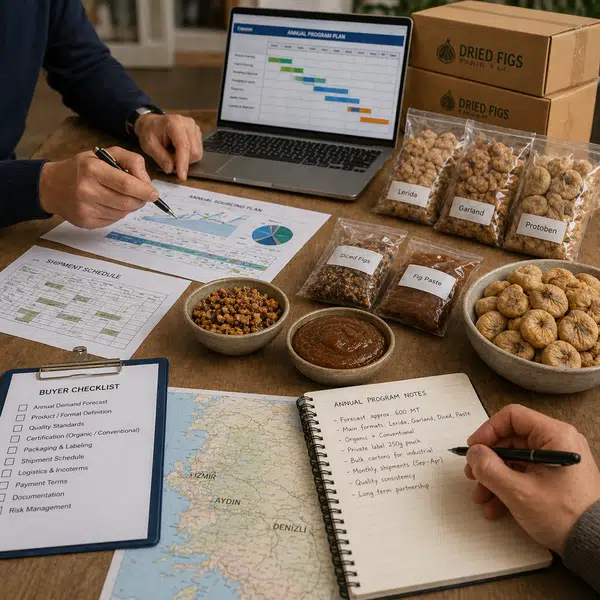
Most successful dried fig buyers do not manage supply one shipment at a time. They build a yearly structure that connects crop timing, format choice, packaging, pricing discipline and stock planning.
Turkish dried figs are closely associated with Aydin and with a broad commercial range that includes Lerida, Garland, Protoben, diced figs and fig paste. Because these formats serve different retail, industrial, foodservice and private label channels, a recurring dried fig business usually needs more than periodic price requests. It needs an annual plan.
Annual programs matter because dried figs are influenced by seasonality, crop development, format preparation, carryover planning, packaging lead times, logistics conditions and approval cycles. Buyers who organize these factors early usually gain better continuity, clearer quotations and fewer avoidable disruptions. Buyers who rely only on spot purchases may still secure supply, but they usually face more variability in timing, price comparability and planning visibility.
An annual program does not always mean a rigid fixed contract. In many cases it simply means that the buyer defines approximate yearly demand, expected shipment rhythm, target formats, certification route and pack logic early enough for the supply discussion to be structured intelligently. This is especially useful for buyers serving supermarkets, private label channels, industrial processing lines or year-round ingredient customers.
That is why annual program building deserves a dedicated article. It helps buyers understand how to move from reactive purchasing to a more disciplined sourcing model that supports repeat performance and commercial stability.
An annual program is not only about total volume. It is about turning that volume into a workable supply structure.
The buyer estimates yearly volume, even if not with perfect precision. This creates a basis for crop-cycle planning, packaging preparation and realistic quotation work.
The buyer identifies whether the requirement is for Lerida, Garland, Protoben, diced figs, fig paste or a mixed-format program. Without that, annual planning remains too broad.
Instead of buying only when stock runs low, the buyer outlines expected call-off timing, seasonal peaks and approximate dispatch cadence.
Retail, private label, foodservice, industrial and bulk routes each require different packing logic. The annual plan should reflect the actual channel structure.
Most annual dried fig programs are built step by step rather than all at once.
The buyer defines which channels will be served, how much dried figs may be needed, which formats are involved and where the strongest commercial priorities sit.
The buyer separates retail presentation formats from industrial formats and bulk routes so the sourcing brief reflects actual commercial use rather than a generic fruit inquiry.
The buyer aligns the annual program with harvest timing, new-crop transition, carryover strategy and the likely availability window for the required formats.
For retail and private label programs, buyer teams usually define pack size, artwork timing, label logic and outer carton structure before the season is fully underway.
The buyer determines whether supply will move in seasonal blocks, recurring monthly orders, quarterly shipments or flexible call-offs against a broader program.
After launch, buyers usually track how well the program performs in volume accuracy, pack consistency, delivered quality and timing so the next cycle can be adjusted more precisely.
Perfect forecasting is rare. Useful forecasting is enough to improve the quality of the sourcing conversation.
Many buyers hesitate to speak in annual terms because they do not yet know exact demand. In practice, however, approximate volume planning is still far more useful than none at all. Even a forecast range helps the supplier understand the likely scale of the program, the required format mix, the packaging implications and the likely shipment rhythm.
For example, an importer buying for several channels may not know exact monthly sales, but they usually know whether the program is small, medium or strategically significant. A cereal producer using diced figs may not know the exact final call-off schedule, but they usually know their general production cycle. A private label retailer may not know the full promotional uplift yet, but they usually know the launch size and the expected base demand. These indications are enough to make the annual discussion much more practical.
Forecasts are also important because they help separate opportunistic spot business from serious recurring programs. Suppliers and buyers can then structure the conversation with the right level of detail and expectation from the beginning.
Strong programs rarely treat all dried figs as one single line. They usually divide the demand by application and commercial route.
These may include Lerida, Garland or other visually important whole-fig programs where consistency, pack readiness and presentation control matter strongly.
Diced figs and fig paste are often planned separately because their production logic, buyer expectations and pack requirements differ from retail whole-fruit programs.
Private label usually requires a separate annual workstream for artwork, label approvals, pack dimensions, barcodes and repeat retail execution.
Bulk supply for repacking, ingredient distribution or foodservice often follows different shipment logic and should be managed as a distinct commercial route within the same annual plan.
Annual programs are stronger when buyers align their planning with harvest and new-crop readiness rather than only with internal purchasing calendars.
Dried fig annual programs are directly affected by crop timing. That does not mean buyers need to manage orchard-level detail, but it does mean they should understand when new-crop planning becomes commercially relevant, when carryover needs to be managed and when key format decisions should be finalized. Buyers who align their planning with the season usually gain more usable quotations and a more realistic supply strategy.
This is especially important where the program includes several formats or several channels. Whole premium figs, industrial diced material and fig paste do not always move through the supply chain in exactly the same way. Annual planning becomes more effective when buyers recognize these differences early and build the calendar around the actual product route.
The annual supply model becomes more reliable when pack decisions and shipment logic are treated as core parts of the commercial plan.
These need earlier coordination because artwork, label approval, consumer unit size and outer carton planning can all affect execution timing.
These should be defined according to warehouse handling, production usage, pallet logic and shipment efficiency rather than by generic packing assumptions.
Programs work better when buyers indicate whether the expected movement is monthly, seasonal, quarterly or call-off based so the supply route can be aligned realistically.
Both can be managed successfully, but they should be structured as clearly defined program routes rather than merged into one vague plan.
Organic dried fig programs often require more planning discipline because certification continuity, pack presentation, label structure and documentation may all be more sensitive to timing. Buyers serving specialist retail or natural channels usually benefit from defining these needs well before the new season is fully active.
Conventional dried fig programs may offer greater flexibility in some industrial or distribution channels, but they still benefit from annual structure. The main advantages are usually better price comparability, more practical shipment timing and fewer interruptions caused by reactive purchasing. Where buyers operate both organic and conventional lines, the strongest approach is to keep the two routes clearly separated in forecasting, documentation and pack logic.
The main value of an annual program is not only lower friction. It is better control across the whole commercial chain.
Offers become more comparable because they are built against a clearer format, pack, channel and timing structure.
Buyers reduce the chance of supply gaps, rushed approvals and last-minute packaging decisions by planning the year in a more structured way.
Sales, procurement, technical, packaging and logistics teams can work from the same program assumptions instead of reacting separately to each shipment.
Specification ambiguity, false price comparison and repeated re-quotation tend to decline when the program is defined more clearly from the start.
Most annual-program problems begin with incomplete planning rather than with the dried fig supply itself.
Whole retail figs, industrial diced material and fig paste should not be managed as one vague product line.
Even an approximate annual estimate is more useful than no planning at all when crop timing and pack preparation are involved.
Packaging often changes the commercial structure enough that it should be defined before final quotation benchmarking.
Year-round programs need a clear bridge between existing stock and new-season availability rather than assuming the switch will happen automatically.
These are different program routes and usually require different calendars, approvals and pack structures.
The best annual programs improve each cycle because buyers review shipment timing, pack performance, delivered quality and forecast accuracy.
A clear planning brief helps Atlas prepare a proposal that reflects a real yearly supply structure rather than a generic quote.
Share the estimated annual demand range, even if provisional, together with any seasonal peaks, promotions or planned launches.
State whether the program involves Lerida, Garland, Protoben, diced figs, fig paste or several formats at once.
Clarify whether the supply is for retail, private label, foodservice, repacking, industrial processing or mixed-channel business.
Define carton, consumer pack, industrial pack, pallet and labeling expectations early so the annual model is commercially realistic.
Confirm whether the program is organic or conventional so the product and documentation route can be aligned correctly.
Indicate whether the expected movement is monthly, quarterly, seasonal or flexible call-off based so the program can be structured practically.
These points help buyers turn dried fig purchasing into a more controlled annual supply model.
Volume alone is not enough. Buyers need format clarity, crop timing, pack planning and shipment rhythm to make the program workable.
Even when exact yearly demand is not yet fixed, a realistic range helps improve quotations and commercial planning significantly.
Retail, private label, industrial and bulk dried fig lines should usually be managed as separate planning streams inside one annual framework.
Annual planning becomes stronger when buyers review forecast accuracy, shipment cadence, pack performance and channel results after each cycle.
A short checklist helps buyers and suppliers move faster toward a practical annual dried fig program.
State whether the discussion is for annual planning, a seasonal campaign, a recurring rolling program or a first structured yearly forecast.
Confirm the exact dried fig formats involved so the annual structure reflects real commercial routes.
Share whether the program serves retail, private label, industrial, foodservice or bulk business.
Provide estimated annual demand, planned peaks and shipment rhythm so the discussion moves beyond spot-buy logic.
Clarify carton, consumer pack, pallet and labeling expectations as early as possible.
State whether the route is organic or conventional so planning, documents and execution can be aligned correctly.
Short answers help buyers review the annual-program topic quickly.
Buyers should first clarify end use, target market, desired format, grade direction, certification profile, preferred pack format and expected shipment rhythm.
Because annual dried fig programs are built through forecasting, crop-cycle planning, format selection, packing structure, logistics timing and commercial risk control rather than by repeating isolated spot purchases.
Yes. Both organic and conventional dried fig programs can be structured annually when the certification route, format, quality level, pack style and shipment plan are aligned with the buyer requirement.
A successful annual program usually depends on realistic volume forecasting, early crop planning, clear format definitions, stable pack logic, practical shipment scheduling, documentation readiness and dependable repeat execution.
Atlas supports buyers who want dried fig supply structured around real yearly demand, crop timing and channel-specific execution.
If your project involves dried figs for retail, private label, industrial use, foodservice or mixed-channel distribution, the most useful next step is to share the approximate annual volume, target formats, certification route, pack structure and expected shipment rhythm. That allows Atlas to build the discussion around a realistic annual supply framework instead of a generic quotation exercise.
Whether the requirement is for a first structured yearly plan or for refinement of an existing recurring program, a clear planning brief usually leads to better timing, stronger quotation quality and smoother long-term continuity.