Retail grade thinking
Retail-oriented grades usually emphasize visible appearance, shape consistency, size harmony, clean presentation and how the product will look in the finished consumer pack.
A practical sourcing and trade guide explaining how dried figs are evaluated by grade, size and quality parameters across retail, industrial, private label and bulk export programs.
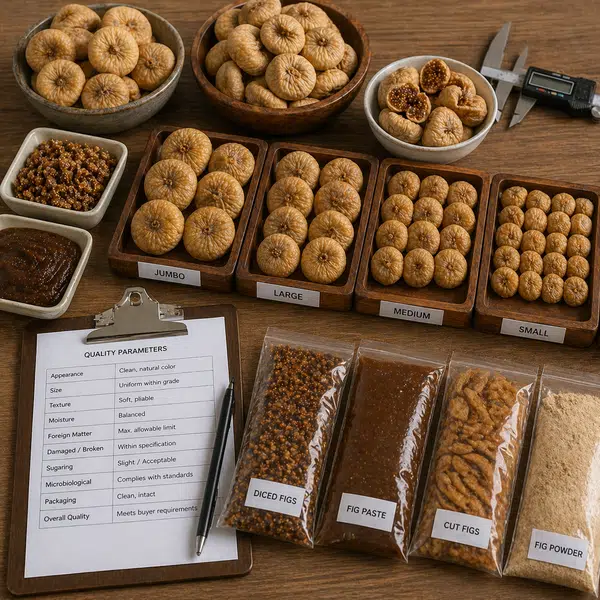
Dried fig quotations become much clearer when buyers define grade, size direction and quality expectations in commercial terms rather than relying on generic product names.
Turkish dried figs are closely associated with Aydin and with a wide range of commercial formats such as Lerida, Garland, Protoben, diced figs and fig paste. Because these routes serve different channels, one buyer’s preferred grade may not be suitable for another buyer’s application. A retail importer may prioritize visual symmetry, size consistency and pack appearance, while an industrial user may care more about cut suitability, process performance and a practical commercial specification.
This is why grade should not be treated as a vague quality label. In dried figs, grade usually reflects a combination of format, size direction, visual condition, handling profile, intended use and commercial route. A premium-looking whole fig may be the right answer for one channel, while a technically consistent industrial format may be the better value for another.
Size matters for similar reasons. Buyers often talk about size as though it were only an appearance issue, but in practice it affects retail presentation, fill weight logic, consumer perception, industrial cutting behavior and quotation comparability. The same is true for moisture direction, softness profile, cleanliness, shape consistency and overall commercial suitability.
That is why grades, sizes and quality parameters deserve a separate discussion. Buyers who define these points clearly usually receive more comparable offers, better samples and a more efficient path toward repeat supply.
Grade is not just a ranking. It is a practical description of how suitable the product is for a particular market or application.
Retail-oriented grades usually emphasize visible appearance, shape consistency, size harmony, clean presentation and how the product will look in the finished consumer pack.
Industrial users often evaluate grade through process suitability, cut consistency, texture direction and whether the format performs correctly in manufacturing rather than how it appears on the shelf.
Private label programs usually combine both views. The fruit must look commercially right in the pack while also remaining consistent enough across repeated orders to support brand continuity.
Bulk buyers often focus on practical suitability for repacking, distribution or further processing, which can lead to different grade priorities from direct retail programs.
Format and grade are closely linked, so buyers should identify the correct product family before discussing size or quality direction.
Often associated with structured retail presentation and clearer visual grading expectations. Size, appearance and pack symmetry usually matter strongly.
A more traditional presentation route where appearance, format identity and market-specific expectations can influence grade discussions.
Relevant where the buyer wants a simpler whole-fruit presentation, often with a different balance between appearance and commercial practicality.
Industrial buyers typically focus more on cut consistency, usable size range and process suitability than on whole-fruit appearance.
Here the grading discussion usually shifts away from whole-fruit visuals toward texture, processing behavior, uniformity and industrial performance.
Some programs require a specification built around a particular manufacturing need, especially in bakery, confectionery or snack applications.
Size is not only a visual variable. It changes the way the product is packed, sold, processed and valued.
For retail and private label, size direction strongly influences shelf appearance and how balanced the product looks inside the pack. Buyers often want a consistent visual impression so that consumer-facing units remain commercially attractive across repeated orders. In these cases, size consistency can be almost as important as the base quality of the fruit itself.
In industrial applications, size may affect the way the fruit is cut, filled, mixed or presented in the finished food system. Larger fruit may not always be better if the application requires efficient dosing, consistent inclusions or controlled process behavior. In other cases, larger visible pieces may add value because the finished product is designed to show premium fruit identity.
For this reason, size direction should be discussed together with format and application. A large-size preference without channel context may produce the wrong commercial solution. The best specification is the one that fits the intended route, not necessarily the one that sounds most premium in isolation.
The most relevant parameters vary by route, but these are the main quality points most serious buyers review.
Especially important in retail and private label. Buyers often review how even the figs look in shape, size direction and general visual presentation.
Softness, body and handling feel matter in both retail and industrial routes. Texture affects eating quality as well as cutting or processing behavior.
Moisture balance influences pack performance, process suitability, stability and the general commercial feel of the product.
These remain fundamental across all routes, whether the product is intended for direct retail, repacking or food manufacturing.
Whole-fruit programs usually watch visible breakage more closely, while industrial users may evaluate whether the product remains commercially usable for the intended process.
For diced figs and paste especially, quality is often defined by how the product behaves in real manufacturing conditions rather than by appearance alone.
Color consistency can influence the commercial impression of the product, especially where fruit remains highly visible in the final pack or application.
Industrial and retail buyers alike usually require a quality profile appropriate for the intended food route and product responsibility framework.
The product should suit the pack style, carton logic and shipment route so that the chosen grade remains commercially acceptable at destination.
The same dried figs may be considered high grade in one route and only acceptable or secondary in another, depending on the use case.
These often place the strongest weight on presentation, symmetry and clean visual appeal because the product is sold directly to the consumer.
These usually require stable retail appearance plus repeat-order consistency, making grade a brand-protection issue as much as a product issue.
In these channels, grade may be defined more by size suitability, cut behavior, paste performance or inclusion quality than by whole-fruit aesthetics.
These buyers often balance commercial practicality and usable quality, which can lead to a different grade definition from direct retail programs.
The strongest dried fig specifications describe the intended commercial route clearly instead of relying on general quality language.
A practical specification usually begins with the format. The buyer first defines whether the requirement is for Lerida, Garland, Protoben, diced figs, fig paste or another route. The second step is size direction. This should reflect the actual market or process need rather than a broad preference for bigger or smaller fruit. The third step is grade direction, meaning whether the priority is premium retail appearance, practical industrial use, private label repeatability or another commercial objective.
After that, the buyer should define the key quality parameters that matter most for the program. For a retail line, these might be visual harmony, presentation quality and consumer pack fit. For an industrial program, they may be cut consistency, texture direction, inclusion behavior or paste performance. Once these points are clear, packaging, shipment rhythm and certification route can be aligned more easily.
Buyers who skip this structure often end up comparing offers that are not truly comparable. Buyers who define the route properly usually move faster from inquiry to useful quotation.
Both can be specified clearly, but buyers should align the quality brief with the commercial route and certification expectations.
Organic dried fig programs often move through premium retail, natural food and specialist channels where visual quality, label clarity and documentation continuity may carry added importance. In these routes, buyers often want the grade and size direction to support both product identity and market positioning.
Conventional programs may be more flexible in some channels, especially where the buyer is serving industrial, foodservice or distribution routes. Even then, clear grading remains important because the same product can still vary significantly in suitability depending on the end use. For recurring supply, both organic and conventional buyers benefit from stable specification language and repeat-order consistency.
Most specification problems come from vague language or from applying one channel’s quality logic to a completely different route.
Premium can mean retail appearance, pack harmony, industrial suitability or origin positioning. Without channel context, it is too broad to guide a quote accurately.
Large fruit is not always the best commercial choice if the application or pack structure requires something different.
Whole retail figs, industrial diced material and fig paste require different quality language and should not be described as if they were the same product route.
The chosen grade should suit the pack format and shipment logic, otherwise the product may not arrive with the intended commercial presentation.
Price comparison only becomes meaningful when size direction, format, channel and quality expectations are defined clearly.
Process-related applications need practical language around cut behavior, consistency and format suitability, not only visual descriptors.
A clear grading brief helps Atlas prepare a proposal that reflects the actual commercial use of the dried figs.
State whether the requirement is for Lerida, Garland, Protoben, diced figs, fig paste or another defined commercial route.
Define the desired size direction in relation to the intended market, pack style or process requirement.
Clarify whether the priority is retail appearance, private label consistency, industrial performance or bulk practicality.
Share the key parameters that matter most, such as visual uniformity, texture, moisture direction, cut consistency or pack-fit suitability.
Confirm whether the route is organic or conventional so the specification and document structure align correctly.
State carton, consumer pack, industrial pack and pallet expectations early because these can influence the right quality direction.
These points help buyers define dried fig specifications more clearly and compare offers more effectively.
Retail, private label, industrial and bulk buyers often use different quality logic even when the product name is the same.
The most suitable size is the one that supports the channel, pack and process requirement, not simply the one that sounds most premium.
Appearance, texture, moisture and cut consistency become useful only when they are linked to the actual application.
Buyers receive stronger, more comparable offers when format, grade, size direction and pack logic are defined from the start.
A short checklist helps buyers and suppliers move faster toward a practical dried fig specification.
Confirm the exact dried fig route before discussing grade or size expectations.
State whether the program is retail, private label, industrial, foodservice or bulk distribution.
Share the preferred size direction in relation to pack format, appearance or processing need.
Define the most important quality parameters for the intended application rather than relying on generic quality language.
Clarify whether the route is organic or conventional so the program is aligned correctly.
Indicate carton, consumer pack or industrial pack expectations early because they influence the commercial suitability of the grade.
Short answers help buyers review the grading topic quickly before moving into quotation and sample discussions.
Buyers should first clarify end use, target market, desired format, grade direction, certification profile and preferred pack format.
Because dried fig grading depends on channel and application. Retail, private label, foodservice and industrial buyers may all use different definitions of acceptable size, appearance, texture and process suitability.
Yes. Both organic and conventional dried fig programs can be specified clearly when size expectations, grade direction, format choice, compliance route and commercial use are aligned.
Because grade is not only a visual concept. It can also reflect processing suitability, retail presentation needs, piece size direction, pack format and the final application of the fruit.
Atlas supports buyers who want dried fig quotations built around clear size, grade and commercial-use definitions rather than broad generic descriptions.
If your project involves dried figs for retail, private label, industrial use, repacking or foodservice, the most useful next step is to share the required format, size direction, key quality priorities, certification route and pack structure. That allows Atlas to prepare a more relevant specification discussion and a more comparable commercial offer.
Whether the requirement is for first samples, a structured sourcing comparison or a recurring annual program, a clear grade brief usually leads to faster alignment and better long-term continuity.