Retail and private label routes
These usually require stronger protection of visual presentation, cleaner outer case condition and more disciplined pallet integrity because the final pack appearance matters commercially.
A practical sourcing and trade guide for buyers who need dried figs to arrive in sound commercial condition, with clear advice on container loading, transit protection, humidity awareness, warehouse handling and post-arrival storage discipline.
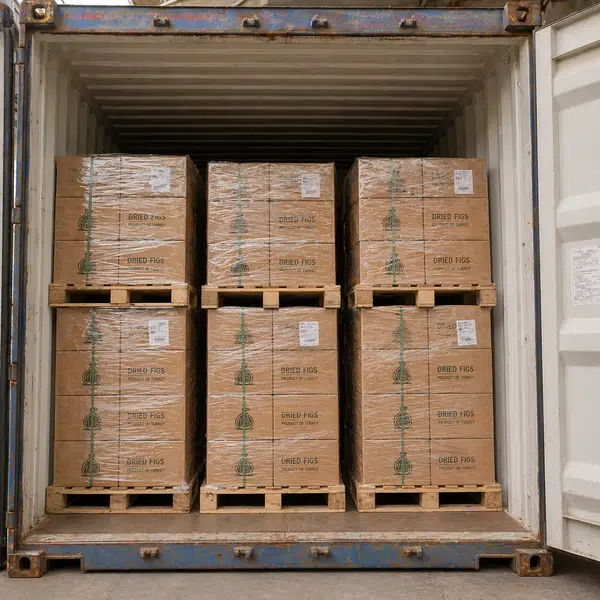
Dried figs are shelf-stable compared with fresh fruit, but they are still sensitive to poor handling, moisture exposure, weak pallet structure and unsuitable storage conditions during export.
Turkish dried figs are closely associated with Aydin and with a range of commercial formats such as Lerida, Garland, Protoben, diced figs and fig paste. These formats move successfully across retail, private label, industrial and bulk channels, but they do not all face the same logistics profile. A premium whole-fig retail line may be more sensitive to visual damage and carton compression, while an industrial format may be more sensitive to pack integrity, lot control and warehouse practicality.
For many buyers, the product decision is already well structured before shipment. The weaker point often appears later, during loading, transit or storage after arrival. A good product can lose value if it is loaded into an unsuitable container, stacked without proper pallet stability, exposed to avoidable condensation or stored in a warehouse environment that does not protect the packed fruit properly.
This is why container loading and storage advice should not be treated as a secondary topic. It directly affects delivered quality, claim risk, commercial continuity and the usefulness of the chosen packaging route. In recurring programs, good logistics discipline is often one of the clearest differences between a reliable supply chain and a merely adequate one.
Buyers who align loading, transit and storage expectations early usually reduce avoidable losses, improve consistency across shipments and create a more dependable annual program overall.
There is no single generic loading strategy for all dried figs. The correct logistics approach depends on the format, packaging type, destination route and commercial channel.
These usually require stronger protection of visual presentation, cleaner outer case condition and more disciplined pallet integrity because the final pack appearance matters commercially.
These often prioritize carton durability, receiving efficiency, pallet practicality and stable transport handling rather than direct consumer presentation.
Diced figs and fig paste usually depend more on pack integrity, clean handling, lot separation and operational efficiency at destination.
Where one shipment or program includes several dried fig routes, the loading and storage plan should reflect the most sensitive commercial requirements rather than assuming all cartons carry equal risk.
The best loading plan protects product quality, pack condition and pallet stability throughout the entire transit route, not only at dispatch.
The container should be suitable for food cargo, free from obvious contamination risks and in a condition that does not introduce avoidable moisture or odor exposure.
Pallet structure should support transit durability, reduce carton movement and help keep the load commercially presentable on arrival.
Outer cases should be appropriate for export handling and not treated as secondary packaging only. In many programs they are part of the delivered commercial value.
The load should be arranged so that excessive pressure, shifting or uneven stacking does not damage the product or reduce pallet usability at destination.
Transit planning should account for vibration, handling, route length and possible re-positioning during shipment, especially where consumer-facing packs are involved.
When shipments involve multiple lots, formats or destinations, clear loading structure helps receiving teams maintain clean lot identification and faster warehouse control.
Dried figs are not a frozen or chilled product, but they are still sensitive to poor moisture control during long-distance movement and warehouse storage.
One of the most important practical risks in dried fruit logistics is uncontrolled humidity exposure or condensation inside the shipping environment. Even when the figs themselves were packed correctly, exposure to poor container conditions or weak storage discipline can affect cartons, product feel and the overall delivered impression. This is particularly important in routes involving seasonal temperature differences or long transit periods.
For buyers, the practical lesson is that transit planning should not focus only on freight booking. It should also consider how the packed dried figs will behave throughout the route and what happens immediately after arrival. Warehouses that are operationally convenient but poorly aligned with dry food storage may create avoidable commercial risk after the shipment lands.
This is one reason why packaging, loading and storage advice should be handled together. A strong inner pack is helpful, but it does not eliminate the need for disciplined external logistics conditions.
Transit success should be judged not only by whether the goods arrive, but by whether they arrive in a condition that is easy to receive, store and sell or process.
Consumer-facing programs often require outer cartons and pallet units to remain commercially clean because damaged presentation can reduce downstream value even when the product is technically usable.
These routes may tolerate different visual expectations, but they still depend on cartons arriving stable enough for practical warehouse movement and ongoing stock control.
Industrial users usually value pack integrity, lot clarity and handling simplicity because receiving delays can affect production planning.
The shipment should be able to transition into destination warehousing without immediate repalletizing or emergency correction where possible.
Arrival is not the end of the logistics process. Dried figs should enter a storage environment that protects both product integrity and commercial usability.
The product should be stored in a clean, dry warehouse environment suitable for packed dried fruit, not in conditions that expose it to avoidable moisture or unstable handling.
The goal is stability and consistency. Sudden or repeated environmental stress can weaken pack performance and reduce overall commercial confidence in the shipment.
Good arrival condition can still be lost quickly if pallets are broken down roughly or moved carelessly during warehouse intake.
For recurring programs, buyers should manage warehouse rotation clearly so stock movement follows the intended plan and commercial continuity remains clean.
Retail-ready cartons may need more presentation care, while industrial cartons may prioritize operational accessibility and lot control.
In foodservice or industrial environments, the way opened packs are handled after receipt can influence the ongoing quality experience as much as the original transit route.
Loading and storage discipline are part of the real commercial cost of a dried fig program, even when they do not appear directly on the product specification sheet.
A lower headline offer may not represent the stronger commercial route if the packaging, pallet logic or transit handling discipline are not sufficient for the destination channel. This is especially true in private label, premium retail and mixed-format programs where visible carton quality and repeat shipment consistency carry genuine commercial value.
Buyers should therefore compare total program quality, not only product price. A better-structured logistics route may reduce claims, receiving problems, repacking costs and internal warehouse friction. In many cases, that produces better total economics than a cheaper but less stable shipment model.
Both routes benefit from strong logistics discipline, but certified or premium-positioned programs may carry higher commercial sensitivity if handling is weak.
Organic dried fig programs often move through premium retail, natural-food and specialist private label channels where packaging integrity, documentation continuity and arrival presentation are commercially important. In these routes, logistics discipline supports not only the product but also the market positioning of the finished pack.
Conventional routes may allow more flexibility in some distribution and industrial channels, but they still benefit from the same basic loading and storage logic. Whether the route is organic or conventional, a stable logistics program usually improves long-term repeatability and lowers avoidable supply-chain friction.
Most avoidable shipment issues come from underestimating the importance of handling and warehouse discipline after the product has been packed correctly.
A sound product at dispatch can still lose value if the container, loading pattern or post-arrival storage conditions are not managed correctly.
Premium retail cartons and industrial supply cartons do not always face the same commercial risk, so loading decisions should reflect the actual route.
Pallet stability often determines how well the shipment survives transit and how efficiently it can be received and stored at destination.
Uncontrolled moisture conditions can create preventable pack and product concerns during longer or more variable transit routes.
Weak warehouse discipline after arrival can create as much commercial risk as weak export loading before departure.
Loading, transit and storage should be discussed as part of the offer, especially in recurring or channel-sensitive programs.
A clear logistics brief helps Atlas prepare a proposal that protects the dried figs throughout export and destination handling.
State whether the product is Lerida, Garland, Protoben, diced figs, fig paste or another route so the handling logic fits the product form.
Clarify whether the shipment is for retail, private label, foodservice, industrial use or bulk distribution.
Share carton strength, inner pack logic, pallet expectations and any special arrival-condition priorities early.
Indicate route complexity, likely transit duration and any known destination constraints that may affect handling or storage.
Consider how the product will actually be received, stored and rotated after arrival so the shipment is planned around real conditions.
State whether the shipment is a one-off trial, a recurring order or part of a larger annual program so logistics discipline can be matched to the program scale.
These points help buyers protect the commercial value of dried figs after packing and before final sale or use.
Even strong dried figs need a loading plan that respects pack structure, pallet stability and the realities of transit.
The shipment should move into a warehouse environment that supports clean dry-food handling and practical stock control.
Retail, private label, industrial and bulk routes should not always be treated with identical logistics assumptions.
Better transit and storage planning can reduce avoidable losses, claims and internal handling friction across recurring programs.
A short checklist helps buyers and suppliers move faster toward a practical dried fig logistics plan.
Confirm the exact dried fig format before discussing container and storage planning.
State whether the program is retail, private label, foodservice, industrial or bulk so the right transit priorities can be applied.
Share carton, inner pack and pallet expectations as early as possible.
Indicate shipment rhythm, route sensitivity and any destination handling concerns that could affect the load plan.
Clarify how the product will be warehoused after arrival so the logistics route supports real post-import conditions.
State whether the shipment is a trial, recurring order or annual program so logistics planning matches the true commercial need.
Short answers help buyers review the logistics topic quickly before moving into shipment planning.
Buyers should first clarify end use, target market, desired format, grade direction, required certification profile, preferred pack format and expected shipment route.
Because dried figs may be commercially sound at origin but still face avoidable risk during export if loading, palletization, humidity control, storage conditions and post-arrival handling are not planned correctly.
Yes. Both organic and conventional dried fig programs benefit from clear transit and storage planning when the format, packaging structure, documentation route and destination handling conditions are aligned.
The main logistics risk is usually not one single factor but a combination of poor packaging, weak pallet logic, uncontrolled humidity exposure, rough handling and unsuitable warehouse storage after arrival.
Atlas supports buyers who want dried fig shipments planned with the right balance of product protection, channel fit and commercial practicality.
If your project involves dried figs for retail, private label, foodservice, industrial use or bulk distribution, the most useful next step is to share the target format, packing structure, destination route, expected warehouse conditions and approximate shipment rhythm. That allows Atlas to structure the discussion around the right loading and storage priorities from the beginning.
Whether the requirement is for a first shipment or a recurring annual program, a clear logistics brief usually leads to stronger delivery performance and fewer avoidable issues after arrival.