Black Raisins

Black Raisins: Seasonality, Harvest Windows and Crop Planning

A practical B2B guide for importers, distributors, repackers and industrial users evaluating black raisins from a seasonal and commercial planning perspective. This article explains how harvest timing, crop conditions, pack commitments, carryover strategy and shipment scheduling influence both availability and buying performance.

Atlas InsightCrop and planning focus
Market UseImporter and industrial view
Trade ViewBuyer timing strategy
Black Raisins: Seasonality, Harvest Windows and Crop Planning

Why this topic matters

Seasonality is one of the most practical buying topics in dried fruit trade because timing affects price, quality, availability and shipment planning.

Black raisins can sit in several value chains at once, from premium retail and repacking programs to bakery, cereal, snack and ingredient applications. Because they are often used as a differentiated alternative to standard sultanas, buyers usually need a clearer sourcing conversation than simply asking for a price per kilogram. They need to define the end use, desired appearance, color depth, moisture profile, pack style, destination market and shipment rhythm before the right commercial structure can be built.

Seasonality matters because black raisins are not only a processed fruit product but also a crop-dependent agricultural item. Harvest timing affects incoming raw material quality, drying results, sizing consistency, visual character and how early export programs can be confirmed. Buyers that understand this timing usually make better sourcing decisions, especially when their requirement is grade-specific, retail-facing or tied to repeat deliveries over a long selling season.

When discussing black raisins for seasonality, harvest windows and crop planning, the first question is usually not “what is today’s price?” but “what kind of program are we trying to build?” A bakery user may care most about stable moisture, manageable texture and reliable industrial continuity. A repacker may focus more on visual uniformity, stem control, sorting level and pack economics. A private label buyer may add artwork deadlines, launch timing and fixed delivery windows. Each of these changes how crop planning should be discussed.

Commercially, successful black raisin programs are usually built around timing discipline, stock planning and realistic specification management. Crop windows, carryover stock, packing availability, packaging materials, freight schedules, pallet planning and market timing all influence final competitiveness. A supplier conversation becomes much smoother when the buyer shares annual demand estimates, target season, pack format and whether the requirement is conventional, natural or organic-linked.
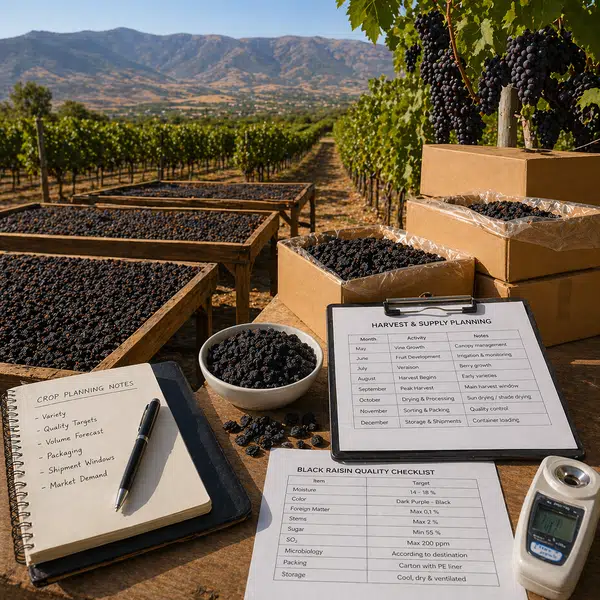
Understanding the seasonal cycle

A basic seasonal map helps buyers understand when to plan, when to negotiate and when to protect continuity.

Pre-harvest planning phase

This is the stage when buyers review expected demand, likely crop size, destination-market priorities, target grades and packaging requirements. For serious importers, this period is commercially important because the earliest discussions often secure better supply visibility and more realistic program planning.

Harvest and drying phase

During harvest and the immediate post-harvest period, supply-side visibility starts improving, but quality and sorting outcomes are still being defined. At this stage, buyers should focus on crop condition, usable yield, early quality signals and the probable timing of export-ready packing.

Early season commercialization

This is often the most sensitive window for pricing and availability because the market begins to react to actual crop data instead of assumptions. Buyers needing specific grades or early shipments should usually be prepared earlier rather than later.

Mid-season program execution

During this period, annual programs, replenishment orders and bulk shipments usually move with greater operational clarity. Buyers compare landed cost, pack efficiency, remaining availability and the balance between spot purchases and stock coverage.

Late season and carryover management

As the season progresses, buyers start evaluating remaining stock, carryover suitability and the risks of waiting too long for replenishment. For black raisins, late-season sourcing may still be viable, but the commercial equation may change depending on available grades, remaining inventory profile, destination timing and whether the buyer needs continuity until the next crop.

Harvest windows and why they influence buying strategy

Harvest timing shapes how early a buyer can commit and how confidently a supplier can structure a program.

Harvest windows are important because they determine when raw fruit becomes available, when drying and sorting operations can begin, and when export-grade commercial supply can realistically be prepared. In black raisins, that timing influences not only physical availability but also how much confidence there is around usable yield, grade mix and visual consistency.

Buyers that are highly sensitive to color tone, berry size, stem tolerance, moisture balance or pack presentation should normally avoid treating all black raisin offers as interchangeable. Early crop timing may offer opportunity, but it can also involve more uncertainty while pack-out quality is still being clarified. Later buying can offer more sorting clarity, but possibly less flexibility if the best lots are already committed.

For that reason, black raisin buying is often strongest when it combines seasonal awareness with application awareness. A bulk industrial user may be more comfortable with a broader quality tolerance if the material performs well in manufacturing. A retail-facing buyer may need earlier allocation discussions if appearance and pack presentation are commercially critical.

Early planning advantage

Improves visibility on supply and helps protect access to preferred grades, pack formats or program volumes.

Mid-season clarity

Usually offers stronger quality visibility, more defined commercial structure and better shipment scheduling confidence.

Late-season caution

May still work for spot buys, but remaining stocks, quality mix and continuity risk should be reviewed carefully.

How crop conditions affect black raisin programs

Crop planning is not only about calendar timing. It is also about how the season performs in practical supply terms.

What buyers usually monitor

  • Expected crop size and usable yield
  • General appearance and color development
  • Berry size distribution and grade mix
  • Drying performance and moisture stability
  • Sorting efficiency and stem or foreign matter control
  • Carryover stock quality from the prior season

Why these points matter commercially

Even when headline availability looks sufficient, the واقعی commercial question is whether the crop can support the required specification at the right timing and at a competitive structure. Crop conditions influence how much material is suitable for premium retail, how much is better for industrial channels and how pricing spreads develop between grades.

Crop variation and specification discipline

Seasonal variation does not automatically make a crop commercially weak, but it does make specification discipline more important. Buyers who define realistic ranges for moisture, size, appearance and pack presentation usually achieve better continuity than buyers who try to benchmark every offer against a fixed ideal regardless of crop context. Strong programs are built around controlled expectations, not only aggressive target pricing.

Planning black raisins by buyer type

Different channels use black raisins differently, so crop planning should match the commercial model.

Importers and repackers

Usually focus on annual supply continuity, landed-cost efficiency, grade stability, repacking suitability and shipment timing across multiple deliveries.

Industrial users

Often prioritize process performance, cutting or blending behavior, moisture control, supply continuity and commercial predictability over purely visual retail appeal.

Retail and private label buyers

Commonly add stricter demands around appearance, label timing, pack presentation, shelf-life expectations and delivery dates linked to launch windows.

Best planning style for recurring buyers

Buyers with ongoing black raisin demand generally perform better with an annual or seasonal program structure than with purely opportunistic spot buying. This helps improve continuity, reduce disruption risk and align packing and shipment windows more efficiently.

Best planning style for trial buyers

Buyers exploring the category for the first time should still define intended application, expected quality level and likely repeat potential. Even a trial order benefits from being planned in a way that can scale if the product performs well commercially.

Commercial timing and price behavior

Seasonality is closely linked to pricing because availability and confidence change as the season develops.

Black raisin pricing is usually influenced by more than harvest alone. Buyers should consider crop size, usable grade yield, pack format, export timing, freight conditions, carton and packaging cost, stock position and market demand from competing channels. However, seasonality still plays a central role because the market behaves differently before crop visibility, during early commercialization and later in the season when remaining stocks become clearer.

Early season buying can sometimes offer strategic supply access, but it may also involve greater uncertainty while the crop is still being assessed. Mid-season can offer stronger commercial clarity, though strong-quality lots may already be allocated. Late-season buying may be attractive for spot coverage in some cases, but buyers should then evaluate continuity risk, quality mix and the cost of bridging into the next crop.

Before crop clarity

Planning discussions matter more than fixed price expectations.

Early commercialization

Availability signals improve, but markets can still move quickly.

Mid-season

Usually the strongest period for structured shipment execution.

Late season

Focus shifts to remaining stocks and continuity into the next cycle.

Inventory strategy and carryover planning

Good crop planning is not only about the new harvest. It is also about how inventory is managed between seasons.

Why carryover matters

Carryover stock can help maintain continuity between harvest cycles, support long-contract deliveries and protect buyers from supply gaps. But carryover only works well when quality, storage condition and commercial suitability remain aligned with the buyer’s requirement.

What buyers should ask

  • Is the required grade available from current stocks or only new crop?
  • Will the remaining stock profile match the intended application?
  • Does the delivery schedule depend on new-crop timing?
  • Is the program based on spot lots or planned replenishment?

Continuity is often worth more than short-term savings

Buyers sometimes focus too heavily on immediate spot price comparisons and underestimate the value of continuity. In black raisins, a stable supply program with predictable quality and shipment timing often creates better total commercial performance than a lower spot price that later causes delays, substitutions or re-approval work.

Key takeaways

These points make the article immediately useful for importers, processors and brand teams.

Insight

Key decision point: define whether black raisins are for industrial, retail, repacking or private label use before setting timing expectations.

Insight

Common buyer need: align grade, moisture, appearance profile and packing format before trying to benchmark price.

Insight

Supply planning note: seasonal crop conditions can influence appearance, usable yield, stock mix and shipment timing.

Insight

Commercial tip: annual or seasonal programs usually achieve better continuity than purely reactive spot buying.

Commercial discussion checklist

A short checklist helps buyers and sellers move faster toward a practical quotation and workable crop strategy.

Product brief

Confirm end use, grade direction, visible quality expectations, moisture tolerance and whether the fruit will be sold as-is or processed further.

Packing brief

Share carton, bag, pallet, retail pack and labeling expectations as early as possible, especially for scheduled or repeated deliveries.

Program brief

State whether the inquiry is for a trial, recurring order, seasonal replenishment, annual contract or private label launch tied to specific market dates.

Best first message from a buyer

A strong first message usually includes the target market, intended application, preferred grade or visual quality profile, pack format, expected volume, required delivery window and whether continuity across the season matters. This makes it much easier to discuss whether the requirement should be built around current stock, new crop, or a blended planning approach.

Mini FAQ

Short answers help buyers review the topic quickly before opening a supply discussion.

What should buyers clarify first for black raisins?

End use, target market, desired grade, required certification profile, annual volume and preferred pack format should be clarified first.

Why create a separate article for seasonality, harvest windows and crop planning?

Because seasonal timing directly affects availability, crop quality, grade mix, shipment planning, stock strategy and the commercial structure of a black raisin program.

Can this topic support both organic and conventional programs?

In many cases yes, provided the fruit and certification profile are aligned with the customer requirement, the available sourcing program and the seasonal supply position.

When is the best time to start planning?

Buyers usually benefit from starting before the new crop is fully commercialized, especially when they need specific grades, retail-facing quality or continuity across multiple shipments.

Quick Contact