Black Raisins

Black Raisins: Private Label and Bulk Export Considerations

A practical B2B guide for importers, distributors, repackers, private label teams and industrial users evaluating black raisins through two different commercial routes: bulk export and retail-ready private label. This article explains how pack structure, grade expectations, labeling, MOQ logic, shipping efficiency and destination-market needs change the right supply model.

Atlas InsightPack and trade strategy
Market UseRetail and bulk routes
Trade ViewBuyer decision framework
Black Raisins: Private Label and Bulk Export Considerations

Why this topic matters

Black raisins may be the same fruit category, but the correct commercial route changes dramatically depending on whether the buyer needs bulk export or a private label retail program.

Black raisins can sit in several value chains at once, from premium retail snacking and branded dried fruit lines to bakery, cereal, ingredient blending and industrial processing. Their darker appearance and stronger visual character can make them commercially attractive in differentiated raisin assortments, healthier snack concepts and premium fruit mixes. For that reason, buyers usually need a clearer commercial discussion than simply asking for a price per kilogram.

The core question is not only “what product is available?” but also “what route should be used to get it to market?” Bulk export and private label are not just two packing options. They are two different commercial systems. Bulk usually prioritizes flexibility, landed-cost control, repacking freedom, industrial suitability and container efficiency. Private label usually prioritizes retail presentation, brand execution, label compliance, fixed packaging decisions, launch timing and higher coordination across artwork, packaging materials and finished-goods logistics.

When discussing black raisins for private label and bulk export considerations, the first question is therefore application fit. Bakery and ingredient buyers often care about size consistency, manageable moisture, processing behavior and delivered cost. Retail buyers may care more about visual uniformity, color tone, pack format, shelf presentation, claims space and barcode or labeling structure. Atlas presents these distinctions clearly so product discussions can move faster and with fewer misunderstandings.

Commercially, strong black raisin programs are usually built around specification discipline, realistic packaging assumptions, shipment planning and market-fit awareness. Bulk routes can fail if the repacker underestimates grading or quality expectations. Private label routes can fail if the buyer underestimates artwork timelines, MOQ constraints, packaging material lead times or retail compliance details. The better the upfront brief, the stronger the final commercial offer becomes.
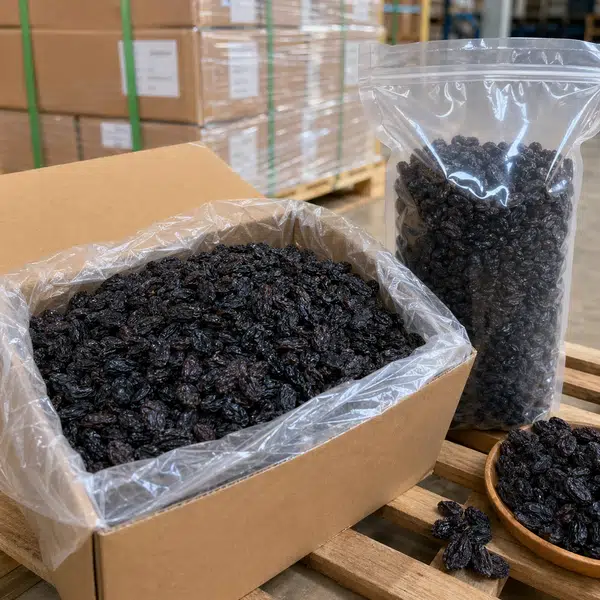
Bulk export versus private label

Choosing the right route early can save time, reduce cost and improve continuity.

Bulk export model

Bulk export is usually the stronger route for importers, repackers, foodservice suppliers and industrial users that want product flexibility after arrival. It supports downstream sorting, local branding, local labeling, format conversion and greater control over final market presentation.

  • Suitable for import and repack businesses
  • Useful for industrial and ingredient channels
  • Often stronger for container efficiency
  • Allows local market adaptation after import
  • Usually more flexible for ongoing replenishment

Private label model

Private label is usually the stronger route when the buyer already has a defined retail concept, fixed packaging direction, artwork process, launch schedule and stable commercial volume. It can reduce post-import handling but requires more coordination upfront.

  • Suitable for retail chains and brand owners
  • Works best with defined packaging structure
  • Requires label and compliance clarity
  • Usually involves more project management
  • Best for consistent repeat programs rather than vague trials

Why buyers should not treat both routes the same

A bulk offer is not simply a private label offer without printing, and a private label offer is not simply bulk packed into a smaller bag. The cost base, operational complexity, lead time and approval workflow are different. Buyers that decide the route early usually get more accurate pricing, better timing clarity and fewer unexpected project delays.

When bulk export is usually the better option

Bulk is often the right route when flexibility, repacking control and total trade efficiency matter more than immediate retail presentation.

Importer-led distribution

Bulk is highly suitable for importers that bring product in at container scale, store locally and repack under one or multiple customer brands.

Industrial ingredient use

Manufacturers using black raisins in bakery, cereal, snack and ingredient applications usually benefit from bulk supply because it keeps the product closer to its working format.

Market-specific adaptation

Bulk gives buyers the freedom to adapt labels, consumer sizes, language, promotions and product mix after import, which is especially useful across multi-country distribution.

Main commercial strengths of bulk export

Bulk export typically offers stronger pallet and container efficiency, simpler approval structure, easier replenishment logic and more freedom in how the product is finally used. For many buyers, especially those with repacking infrastructure or industrial demand, bulk is the more commercially efficient route unless a finished retail format is essential from the start.

When private label is usually the better option

Private label becomes more attractive when the buyer already knows the final product, final package and final market.

Retail-ready execution

Private label works well when the product must arrive already packed for shelf placement, branded distribution or direct customer fulfillment.

Brand consistency

Buyers with established visual guidelines, pack architecture and label claims often prefer private label to protect brand consistency across markets.

Operational simplicity after arrival

Where downstream repacking is costly or impractical, private label can simplify post-import handling by moving more of the work upstream.

Main commercial requirements for private label

Private label generally requires clearer MOQ structure, packaging material coordination, approved label text, artwork timing, barcode strategy, pack format decisions and destination-market compliance awareness. It is strongest when the buyer has stable demand and a retail plan that justifies the added complexity and finished-goods structure.

Product and quality considerations by route

The same black raisin category may need a different quality profile depending on whether it is sold in bulk or as a finished retail product.

Bulk buyers usually prioritize

  • Grade and size consistency
  • Moisture suitability for repack or processing
  • Sorting level and foreign matter control
  • Container and pallet efficiency
  • Total landed cost and ongoing availability

Private label buyers usually prioritize

  • Retail appearance and visual uniformity
  • Consumer-facing pack presentation
  • Label claims and ingredient list accuracy
  • Consistent pack weight and fill control
  • Shelf-life and packaging performance

Why quality targets should be route-specific

A retail-ready private label project usually needs tighter appearance discipline than an industrial bulk program. Conversely, an industrial buyer may prioritize process suitability over visual perfection. The best commercial discussions avoid using one generic quality expectation across all routes and instead define which characteristics actually drive value in the intended market.

Packing considerations

Packing is one of the most important cost and execution variables in black raisin trade.

Bulk packing discussions often include

  • Carton size and net weight
  • Inner liner structure
  • Pallet pattern and loading efficiency
  • Warehouse handling convenience
  • Protection during longer transit routes

Private label packing discussions often include

  • Pouch, tray or carton format
  • Retail-facing visual design
  • Label language and barcode placement
  • Secondary case configuration
  • Shelf display logic and transport durability

Packaging affects more than appearance

Packaging influences transit performance, storage efficiency, shelf-life behavior, customer presentation, picking speed and overall landed cost. In many cases, the pack decision has as much commercial impact as the product price itself. That is why buyers should define pack logic early rather than leaving it to the last stage of the discussion.

MOQ, volume and program structure

Volume expectations strongly affect whether private label is practical or whether bulk is the more efficient route.

MOQ logic is one of the biggest commercial differences between bulk export and private label. Bulk can often be more forgiving because it uses simpler packing systems and supports local conversion after arrival. Private label usually becomes more economical only when the buyer can commit to commercially workable run sizes for packaging materials, production efficiency and finished-case handling.

Buyers considering private label should therefore think not only about initial trial volume, but also about repeat potential, SKU count, artwork stability and how often the product will be reordered. Bulk buyers should focus more on container build, replenishment frequency, warehouse flow and whether the imported product will be distributed directly or converted into smaller formats locally.

Trial stage

Bulk is often more practical during early validation unless the retail concept is already fully defined.

Growth stage

Private label becomes more attractive when repeat volume and pack architecture are already stable.

Program stage

Long-term private label or mixed bulk-plus-retail strategies can work well when volumes justify dedicated planning.

Documentation and market-readiness

Private label usually requires deeper documentation coordination than bulk, but both routes need clarity.

Typical bulk documentation focus

  • Commercial invoice
  • Packing list
  • Certificate of origin
  • Product specification sheet
  • Analysis or agreed compliance records

Typical private label documentation focus

  • All standard shipment documents
  • Final label text approval
  • Ingredient declaration structure
  • Barcode and pack copy review
  • Retail-facing pack specification alignment

Why documentation affects commercial success

A buyer may approve the product itself but still delay the project if the packaging workflow, label copy, compliance wording or shipment paperwork are unclear. Bulk routes generally move faster because there are fewer finished-goods approval steps. Private label can still be commercially strong, but only when the documentation process is treated as part of the project from the beginning.

Commercial planning by buyer type

The best route often depends less on the fruit itself and more on the structure of the buyer’s business.

Importers and repackers

Usually prefer bulk for flexibility, local branding, better warehouse control and the ability to serve multiple downstream customer types from one imported stock position.

Retail chains and brand owners

Often prefer private label when the product has a clear shelf role, fixed pack style, defined label claims and stable recurring demand.

Industrial users

Most often prefer bulk because finished retail presentation is not the main value driver. Processing performance, price structure and continuity matter more.

Hybrid models are also possible

Some buyers use a hybrid strategy: bulk for industrial or wholesale channels, and private label for selected retail SKUs. This can be commercially effective when the buyer wants both flexibility and branded shelf presence without forcing every volume stream through the same packaging logic.

Key takeaways

These points make the article immediately useful for importers, processors and brand teams.

Insight

Key decision point: define whether black raisins are for industrial, retail, repacking or private label use before comparing offers.

Insight

Common buyer need: align grade, moisture, appearance profile and pack format before trying to benchmark price.

Insight

Supply planning note: private label requires more early coordination on packaging, label content and MOQ than bulk export does.

Insight

Commercial tip: bulk often suits flexibility and landed-cost control, while private label suits defined retail concepts and repeat structured programs.

Commercial discussion checklist

A short checklist helps buyers and sellers move faster toward a practical quotation and the right supply route.

Product brief

Confirm end use, grade, visible quality expectations, target price position and whether the fruit will be sold as-is or further processed.

Packing brief

Share carton, pouch, bag, pallet, retail pack, barcode and labeling expectations as early as possible.

Program brief

State whether the inquiry is for a trial, recurring order, annual contract, repacking program or private label retail launch.

Best first message from a buyer

A strong first message usually includes the target market, intended application, preferred route, expected volume, packaging direction and any critical retail or industrial constraints. This makes it much easier to determine whether the project should move forward as bulk export, private label, or a combined multi-channel structure.

Mini FAQ

Short answers help buyers review the topic quickly before opening a supply discussion.

What should buyers clarify first for black raisins?

End use, target market, desired grade, required certification profile, annual volume and preferred pack format should be clarified first.

Why create a separate article for private label and bulk export considerations?

Because bulk import, industrial handling, repacking and private label retail programs all require different quality targets, packaging workflows, MOQ logic and commercial assumptions.

Can this topic support both organic and conventional programs?

In many cases yes, provided the fruit and certification profile are aligned with the customer requirement, the available sourcing route and the pack concept being considered.

When does private label usually make more sense than bulk?

Private label usually makes more sense when the buyer has a defined retail concept, stable repeat volume, approved label structure and a market plan that justifies finished retail packaging from origin.

Quick Contact