Certification
This usually refers to formal third-party or audited status linked to the site, product or supply chain, such as organic scope or other recognized program requirements relevant to the buyer's channel.
A practical buyer and exporter guide covering the certifications, compliance expectations and documentation flows that shape apricot kernel programs in export markets.
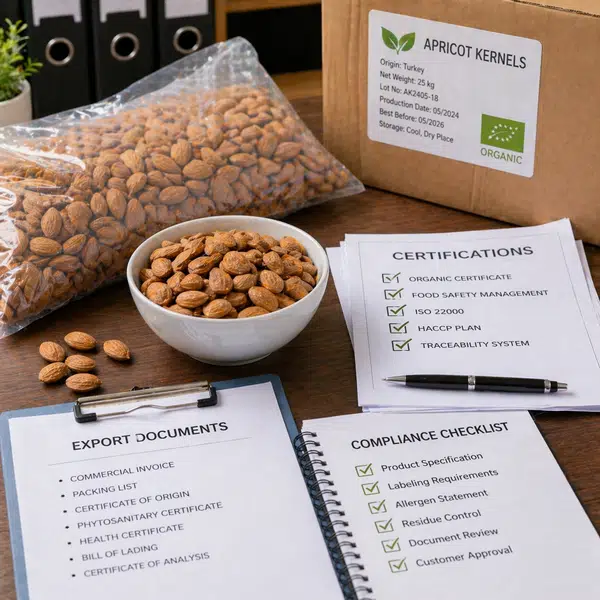
Apricot kernels may be commercially suitable, but the program can still fail if the certification scope, export paperwork or labeling logic do not match the target market and customer channel.
Apricot kernels can sit in several value chains at once, from industrial ingredient supply and food manufacturing to retail, foodservice and private label. For that reason, buyers usually need a clearer conversation than simply asking for a price per kilogram. They need to define the kernel type, end use, target market, acceptable quality, packaging structure and shipment rhythm before the right commercial offer can be structured properly.
When discussing certifications, compliance and documentation, the first question is application fit, but the second is market fit. A bakery manufacturer, confectionery processor, snack mix producer, importer or retail brand may all buy apricot kernels, yet each may require different evidence, declarations, certificates and label logic. Some need straightforward bulk export documentation, while others require broader onboarding files, organic certification flow, private label approval sets or customer-specific declarations.
Commercially, strong apricot kernel programs are built around timing and specification discipline, but they also depend on documentation readiness. Product type, packaging, certification profile, market destination, channel claims and private label requirements can all affect what needs to be prepared before shipment. A supplier conversation becomes much smoother when buyers share annual demand estimates, destination market, intended channel and whether the requirement is conventional or organic, industrial or retail-ready.
This article helps importers, processors, distributors and brand teams understand what usually sits under the heading of compliance in real apricot kernel trade. It shows why certification scope, declaration logic and document completeness should be discussed early, not only after price negotiation has already begun.
These terms are related, but they are not the same thing. Confusing them often leads to weak quotations and later delays.
This usually refers to formal third-party or audited status linked to the site, product or supply chain, such as organic scope or other recognized program requirements relevant to the buyer's channel.
This usually refers to whether the product, process, labels and supporting information align with the destination market, customer rules and intended application.
This covers the broader file set needed to support approval, shipment and receiving, including technical, commercial and logistics-related paperwork.
Some buyers need more than standard export documents. They may require declarations, questionnaires, label reviews or supplier onboarding files before the first order is approved.
The required document set often changes by market and by channel. A bulk industrial sale and a private label retail program rarely operate with the same paperwork burden.
For repeat business, consistent documentation matters almost as much as consistent product supply. Missing or changing files can interrupt an otherwise workable program.
The exact certification profile depends on the destination market, customer type and whether the program is conventional or organic.
Where organic apricot kernels are involved, buyers usually need the product, packaging and claims flow to remain fully aligned with the relevant certified program. This often requires earlier planning than a comparable conventional transaction.
Some customers want visibility on how the production and packing environment is controlled, especially when the kernels will enter industrial or branded retail channels.
Retail brands, importers, distributors and manufacturers may each ask for different evidence, depending on their own customer base and risk management logic.
A valid certification profile does not eliminate the need for a clear written product specification. Both usually need to work together.
Compliance discussions usually go beyond the product itself and include how the apricot kernels are described, packed and supported commercially.
Buyers normally want clarity on kernel type, commercial description, intended application and whether the product is aligned with the target channel.
Where labels are involved, especially in foodservice or retail, wording, pack identity, claim usage and presentation structure need to fit the target market and customer requirement.
The packaging format used in the transaction should match the declared product and the intended commercial route, whether bulk, foodservice or retail-ready.
Some customers require additional declarations or questionnaires as part of supplier approval, risk review or ongoing file maintenance.
Compliance also includes whether the goods can actually move into the destination market smoothly with the right paper trail, label structure and commercial support.
One successful shipment is not enough if later shipments use inconsistent labels, document sets or approval files. Stable compliance practice supports annual programs.
The final file set depends on market and channel, but buyers usually review several layers of documentation rather than only one export paper.
Commercial documents: These usually support the transaction and shipment flow itself. Accuracy here matters because even simple errors can delay clearance or receiving.
Technical documents: These usually describe the product commercially and technically. Buyers often rely on them during approval, quality alignment and ongoing program management.
Certification-linked documents: Where a certified program is involved, the related file flow should remain consistent with the product claim and the commercial structure of the shipment.
Label-related files: Foodservice, retail and private label customers may all need label approval or wording confirmation before shipment, especially when the product is sold in finished units.
Shipment support files: These help the buyer receive, identify and integrate the shipment into their own quality, warehouse and import systems.
Customer onboarding files: Large importers, brands or industrial accounts may request questionnaires, declarations or supplier information packs in addition to the standard transaction documents.
Compliance and documentation requirements affect workload, timing and sometimes the commercial structure of the program itself.
A simple bulk industrial program and a private label retail launch rarely require the same level of paperwork, review and administrative coordination.
If certifications, labels or declarations need review before dispatch, the lead time should reflect that. Treating documentation as a final-step issue often creates avoidable delays.
Many first orders stall not because the product is unavailable, but because the buyer and supplier did not align the required file set early enough.
Two offers may appear similar until one of them includes broader compliance support, private label approval work or a more complex certification structure.
These two channels often require more document discipline than straightforward conventional bulk trade.
Organic transactions usually require earlier alignment on product status, packaging flow, claim logic and supporting certification-linked documents so the integrity of the program remains clear across the full supply chain.
Private label programs often require more control over label wording, pack identity, barcode logic, declaration files and consistency across repeated production runs. Documentation here is part of the product itself.
Some buyers use the same sourcing base for industrial, foodservice and retail channels. In these cases, the supplier and buyer should separate the document logic clearly for each route.
Where programs are recurring, document maintenance becomes part of program management. Stable file handling supports stable commercial performance.
Most compliance problems arise from incomplete planning rather than from the absence of product supply.
Requirements can change by market, channel and customer. Using one standard document assumption for all cases is often too simplistic.
If a buyer raises certification scope only after price and lead time have been discussed, the offer may need to be restructured.
For foodservice, retail and private label, labeling is part of compliance and should not be treated as a purely cosmetic final step.
The document set is easier to prepare accurately when the supplier knows whether the goods are for industrial use, foodservice, private label or finished retail sale.
Documentation quality weakens when the product itself is still described too broadly or ambiguously in the commercial discussion.
Even when the first order works, weak document discipline across later shipments can destabilize an otherwise successful annual program.
A clearer compliance brief produces a more realistic quotation and a smoother approval process.
Confirm kernel type, intended use, organic or conventional status and the exact commercial description expected by the buyer.
State the destination market and whether the product is for industrial processing, foodservice, repacking, private label or direct retail sale.
List the certification profile required for the program rather than assuming that all suppliers or channels will interpret the requirement the same way.
Explain which technical files, shipment papers, declarations, questionnaires or onboarding documents are expected before dispatch.
For packed product, define label wording, brand logic, barcode expectations and whether local-market review is needed before printing.
Clarify whether the request is for a trial order, recurring shipment flow or annual program so document continuity can be planned properly.
These points make the article immediately useful for importers, processors, distributors and brand teams.
A successful apricot kernel program usually needs the right certificate profile, the right label logic and the right supporting file set.
Waiting until after price discussion to define document scope often creates avoidable revisions and delays.
Industrial bulk, foodservice, private label and retail programs usually do not require identical compliance and documentation structures.
These channels often require earlier and more detailed alignment on claims, certificates, labels and supporting files.
The more precisely the buyer defines certification and documentation expectations, the easier it becomes to structure a realistic offer.
Stable document handling across shipments supports smoother annual programs and stronger commercial trust.
A structured checklist helps buyers and suppliers move from a general inquiry to a workable certification and documentation plan.
Confirm kernel type, intended use, organic or conventional status and the target market the goods are intended for.
State whether the goods are for industrial use, foodservice, repacking, private label or direct retail sale.
List the certification profile the buyer requires rather than relying on broad general assumptions.
Share the expected declarations, technical files, onboarding documents and shipment paperwork at the quotation stage.
For packed programs, define wording, barcode, claim and approval expectations as early as possible.
Clarify whether the request is for a trial, recurring flow or annual supply model so file continuity can be planned properly.
Short answers on apricot kernel certifications, compliance and documentation.
Buyers should first clarify kernel type, end use, target market, desired grade, certification profile, documentation needs and preferred pack format.
Because apricot kernel programs often succeed or fail based on more than product price. Certification scope, labeling logic, customer approval files and export documents all affect whether the shipment can move smoothly into the target market.
In many cases yes, provided the kernel type, certification profile, documentation flow and labeling structure are aligned with the customer requirement and the available sourcing program.
Certification usually refers to formal audited status or third-party recognized schemes, while documentation includes the broader commercial, technical, shipment and declaration paperwork needed to support approval and export execution.
Because required certificates, declarations, labeling expectations and customer onboarding files affect the operational scope of the program and can materially change both timing and commercial structure.
No. The final document requirement usually changes by market, customer type and sales channel, which is why the buyer should define the route to market clearly before the offer is finalized.